15874196392
No. A6-608 Lugu International Industrial Park, Yuelu District, Changsha 410205, Hunan, P.R China
Taro is moving beyond its traditional roots and becoming a distinctive flavor and ingredient for modern beverages. From bubble tea and milk tea to smoothies, lattes, desserts, and ready-to-drink products, taro offers beverage manufacturers a combination of recognizable flavor, attractive color, creamy texture, and strong visual appeal.
As consumers continue to explore new flavors and beverage experiences, taro has gained attention far beyond the markets where it has traditionally been consumed. For beverage brands and ingredient buyers, this creates an interesting opportunity: could taro become one of the next major global beverage flavors?
The answer may depend less on whether taro becomes a short-term trend and more on whether manufacturers can successfully adapt it to different beverage formats, consumer preferences, and global markets.
For B2B beverage manufacturers, food companies, ingredient distributors, and private-label brands, understanding the potential of taro now can help identify new product opportunities before the market becomes saturated.
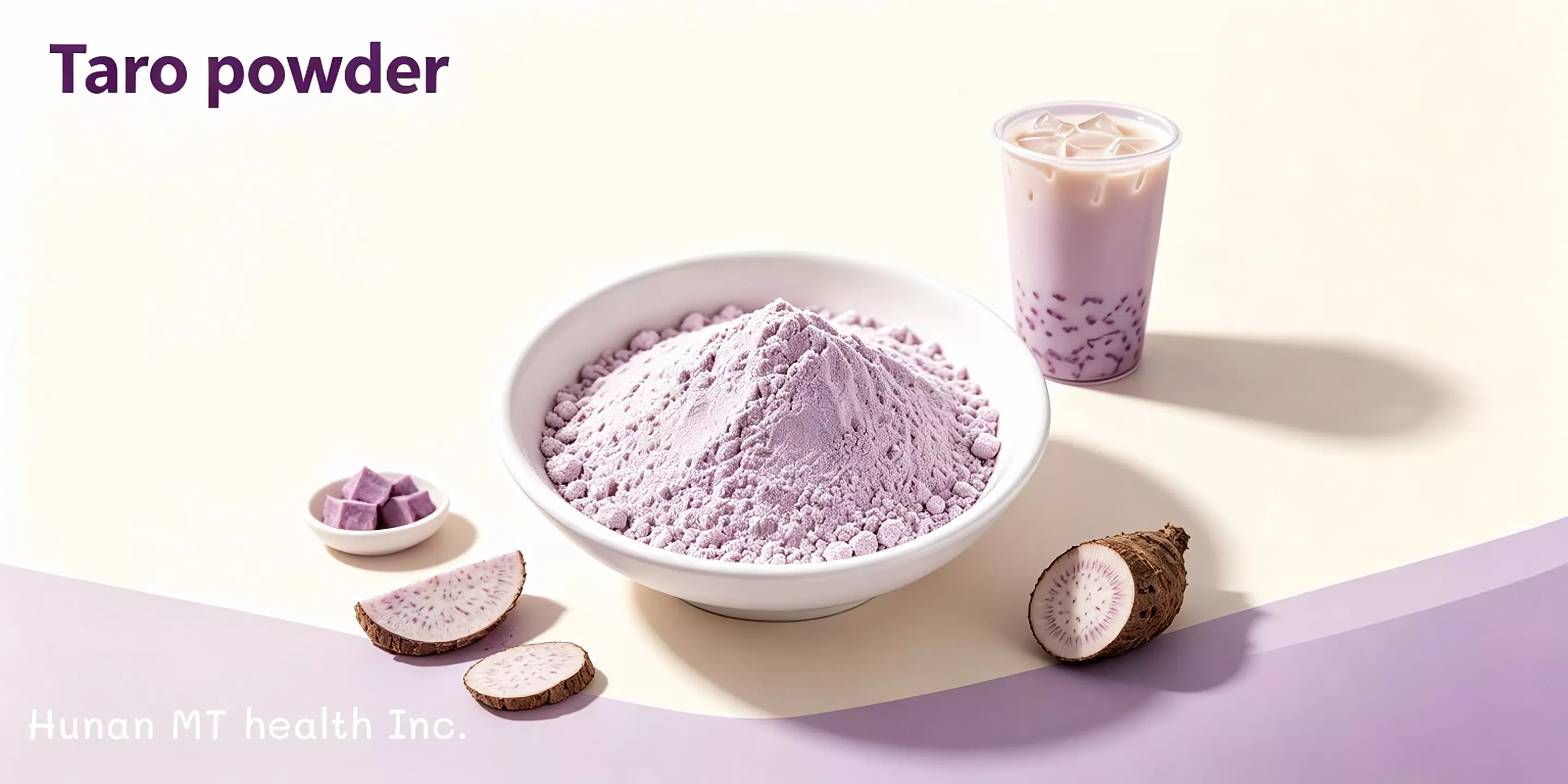
Taro is the edible underground stem, or corm, of Colocasia esculenta, a plant widely cultivated and consumed in many parts of Asia, the Pacific Islands, Africa, and other tropical and subtropical regions.
Unlike highly concentrated fruit flavors, taro has a relatively mild and distinctive sensory profile. Depending on the formulation and processing method, taro-inspired beverages can deliver notes often described as creamy, nutty, mildly sweet, earthy, and vanilla-like.
This flavor profile gives taro an important advantage in beverage development.
It does not necessarily need to compete directly with familiar fruit flavors such as strawberry, mango, or lemon. Instead, it creates a different type of drinking experience.
Taro can be used to build beverages that consumers perceive as:
This versatility is one reason taro has become closely associated with modern milk tea and bubble tea culture.
One of the most visible drivers of taro’s international popularity is bubble tea.
Bubble tea originated in Taiwan and developed into a global beverage category. As the category expanded internationally, consumers were introduced to a broader range of flavors beyond traditional tea and fruit combinations.
Taro became one of the recognizable flavors within this category.
Taro milk tea, taro smoothies, taro slushes, and taro-based specialty drinks have appeared across beverage menus in different markets. Its popularity is particularly relevant because bubble tea shops are not simply selling beverages—they are selling flavor discovery and visual experience.
This matters for ingredient suppliers.
When a flavor becomes recognizable within one fast-growing beverage category, it can potentially move into adjacent categories.
For example, a taro-inspired concept can be adapted into:
The opportunity is therefore not limited to traditional bubble tea.
There are several reasons why taro fits current beverage innovation.
The beverage market is highly competitive. Traditional flavors remain important, but brands are constantly looking for ways to differentiate their products.
A beverage based on taro immediately sounds different from another strawberry, vanilla, or chocolate drink.
For younger consumers and adventurous shoppers, unfamiliar ingredients can create curiosity and encourage trial.
Taro also benefits from being unfamiliar enough to feel innovative while already being established enough in Asian food culture to have a recognizable identity.
That balance is valuable for product development.
Flavor is only one part of modern beverage marketing.
Color and appearance increasingly influence how consumers discover and share products, particularly on visual platforms and social media.
Taro beverages are commonly associated with light purple, lavender, or creamy purple tones. This gives beverage brands an opportunity to create products that stand out visually.
A visually distinctive drink can be particularly useful for:
For B2B brands, this means taro can contribute not only to flavor positioning but also to the overall product concept.
Another advantage is compatibility.
Taro does not have to be used alone. Its flavor can be combined with familiar ingredients to create more accessible formulations.
Popular combinations can include:
Taro + Milk
A classic combination that creates a creamy and comforting beverage profile.
Taro + Tea
Suitable for milk tea and specialty tea beverages.
Taro + Coconut
Useful for tropical-inspired beverages and plant-based formulations.
Taro + Coffee
Can be developed into a visually distinctive taro latte or specialty coffee concept.
Taro + Vanilla
Vanilla can complement the naturally mild and creamy sensory profile associated with taro.
Taro + Chocolate
A useful combination for dessert-style beverages and indulgent applications.
These combinations allow product developers to introduce taro without requiring consumers to completely change their flavor expectations.
The most interesting question is not whether taro can succeed in bubble tea.
It is whether taro can move into a wider range of beverage categories.
The answer is potentially yes.
Taro latte products can position the ingredient as an alternative to more familiar café flavors.
Depending on the formulation, a taro latte can be served hot or cold and may be suitable for cafés, specialty beverage chains, and foodservice applications.
Taro works naturally with smoothie concepts because smoothies already accommodate fruit, vegetables, dairy, plant-based ingredients, and powdered ingredients.
Taro powder can be combined with ingredients such as banana, coconut, or other fruit components to create new flavor profiles.
Milk tea remains one of the most established applications for taro.
For manufacturers supplying bubble tea shops and beverage chains, taro can be incorporated into powdered beverage mixes or used as an ingredient in customized formulations.
RTD beverages represent another potential direction.
Brands can explore taro-inspired products in cans, bottles, or other convenient formats.
However, formulation stability, flavor consistency, color stability, processing conditions, and consumer expectations need to be carefully evaluated during product development.
Taro can also be positioned within indulgent beverage concepts.
Examples include taro shakes, dessert smoothies, creamy blended drinks, and specialty café beverages.
This makes taro particularly interesting for brands targeting consumers who view beverages as an occasional treat or experiential product.
For commercial beverage production, ingredient format is an important consideration.
Fresh taro can provide a traditional ingredient experience, but it also creates practical challenges related to storage, transportation, preparation, consistency, and processing.
Taro powder can offer a more convenient format for certain industrial and foodservice applications.
Depending on the specific product specification and processing method, powdered taro ingredients may provide advantages such as:
However, buyers should not assume that every taro powder has the same characteristics.
Particle size, moisture, processing method, color, flavor profile, microbiological specifications, packaging, and application performance can all influence the final product.
For this reason, professional B2B buyers should evaluate ingredient specifications and application performance rather than selecting a supplier based solely on price.
When sourcing taro powder for commercial beverage development, buyers should consider several technical and commercial factors.
Confirm whether the ingredient is genuine taro powder and understand the raw material source and processing method.
The flavor should be evaluated in the actual beverage application rather than only from the dry powder.
If the finished product requires a specific visual appearance, color consistency should be evaluated across batches.
Different beverage applications require different performance characteristics.
A powder intended for instant beverages may need different specifications from an ingredient used in smoothies or bakery applications.
Moisture content can influence powder handling, shelf stability, and processing behavior.
Commercial food and beverage manufacturers should work with suppliers that provide appropriate quality documentation and testing according to the intended market and application.
Packaging should protect the powder from moisture and environmental exposure during transportation and storage.
For B2B buyers, the ability to provide samples, stable specifications, flexible packaging, reliable lead times, and scalable production can be just as important as the ingredient itself.
Food trends often follow a familiar pattern.
A new flavor initially appears in niche cafés or specialty foodservice. It then attracts social media attention. Beverage chains begin experimenting with it. Ingredient suppliers develop standardized formats. Finally, mainstream brands begin testing the flavor in packaged products.
Taro has already passed several stages of this process in certain markets.
Its history as a traditional food ingredient provides cultural familiarity, while its distinctive color and flavor make it suitable for modern product innovation.
This combination gives taro an interesting position in the global beverage landscape.
Rather than being simply another exotic flavor, taro can be viewed as a bridge between traditional ingredients and contemporary beverage culture.
That positioning could help it remain relevant beyond short-lived social media trends.
For ingredient distributors and beverage manufacturers, the opportunity is not necessarily to launch a product simply because taro is trending.
A stronger strategy is to identify where taro solves a real product-development need.
For example:
A bubble tea brand may use taro to expand its milk tea menu.
A café chain may develop a seasonal taro latte.
A powdered beverage manufacturer may create an instant taro drink mix.
A smoothie company may introduce a creamy taro-based flavor.
A private-label brand may develop a visually distinctive specialty beverage.
A food ingredient distributor may add taro powder to its portfolio to serve beverage and dessert manufacturers.
This is where ingredient quality and supplier capability become important.
A trend creates demand, but consistent supply and reliable product specifications determine whether a commercial product can scale.
At Hunan MT Health, we focus on supplying plant-based ingredients for food, beverage, and functional product development.
Our approach is centered on helping B2B customers move from ingredient sourcing to practical product application.
For customers evaluating taro powder, the process can include:
For beverage manufacturers, the goal is not simply to supply taro powder.
The goal is to provide an ingredient that can fit into a commercially realistic product-development process.
Taro is generally associated with a mild, creamy, nutty, earthy, and slightly sweet flavor profile. The final taste depends on the raw material, processing method, formulation, and other ingredients used in the beverage.
Taro provides a distinctive flavor and attractive visual identity while pairing well with milk, tea, and other beverage ingredients. This makes it suitable for specialty bubble tea and milk tea formulations.
No. Taro-inspired formulations can also be explored for lattes, smoothies, shakes, instant beverages, dessert drinks, and other food and beverage applications.
Taro powder can be used in commercial beverage development, but suitability depends on the product specification and application. Buyers should evaluate flavor, color, particle size, moisture, microbiological quality, dispersibility, and other relevant parameters.
B2B buyers can work directly with ingredient manufacturers or qualified suppliers. Before purchasing, it is advisable to request product specifications, samples, quality documentation, packaging information, and commercial terms.
Taro has many characteristics that make a beverage ingredient commercially interesting: a recognizable cultural background, a distinctive flavor profile, strong visual appeal, compatibility with dairy and plant-based formulations, and versatility across different beverage formats.
Its future growth will ultimately depend on consumer acceptance, formulation quality, pricing, distribution, and how successfully beverage brands adapt taro to local tastes.
But one point is already clear:
Taro is no longer limited to traditional food applications or a single bubble tea category. It has become a credible ingredient for beverage innovation.
For B2B beverage manufacturers and ingredient distributors, now may be the right time to evaluate where taro could fit within their product portfolios.
Whether you are developing a taro milk tea, taro latte, smoothie, powdered beverage, specialty café drink, or a new RTD concept, choosing the right ingredient supplier is an important first step.
Looking for taro powder for your next beverage project? Contact Hunan MT Health to discuss product specifications, samples, application requirements, and bulk sourcing options.
The next successful beverage flavor does not always have to come from a completely new ingredient.
Sometimes, it comes from taking a traditional ingredient and giving it a new place in the global market.
Taro may be one of those ingredients.
15874196392
No. A6-608 Lugu International Industrial Park, Yuelu District, Changsha 410205, Hunan, P.R China



 TH
TH  EN
EN  FR
FR  DE
DE  ES
ES  RU
RU  JA
JA  KO
KO  AR
AR  PT
PT  ZH
ZH