15874196392
No. A6-608 Lugu International Industrial Park, Yuelu District, Changsha 410205, Hunan, P.R China
Choosing the right taro ingredient for consistent flavor, texture, and large-scale production
Taro milk tea has become a familiar product in bubble tea shops worldwide. Its creamy texture, mild nutty flavor, and distinctive appearance make it an attractive option for beverage brands.
However, not all taro powders are suitable for commercial bubble tea manufacturing.
Some products contain pure taro root powder, while others are ready-to-use blends containing sugar, creamer, flavorings, and coloring ingredients. Their performance, cost, and formulation flexibility can differ significantly.
The best taro powder for bubble tea manufacturers is the one that delivers the required flavor, texture, color, and batch consistency under actual production conditions. For brands developing proprietary recipes, pure taro powder may offer greater formulation control. For operators prioritizing convenience, a formulated premix may be more practical.
This guide explains how B2B buyers can evaluate taro powder before selecting a supplier.
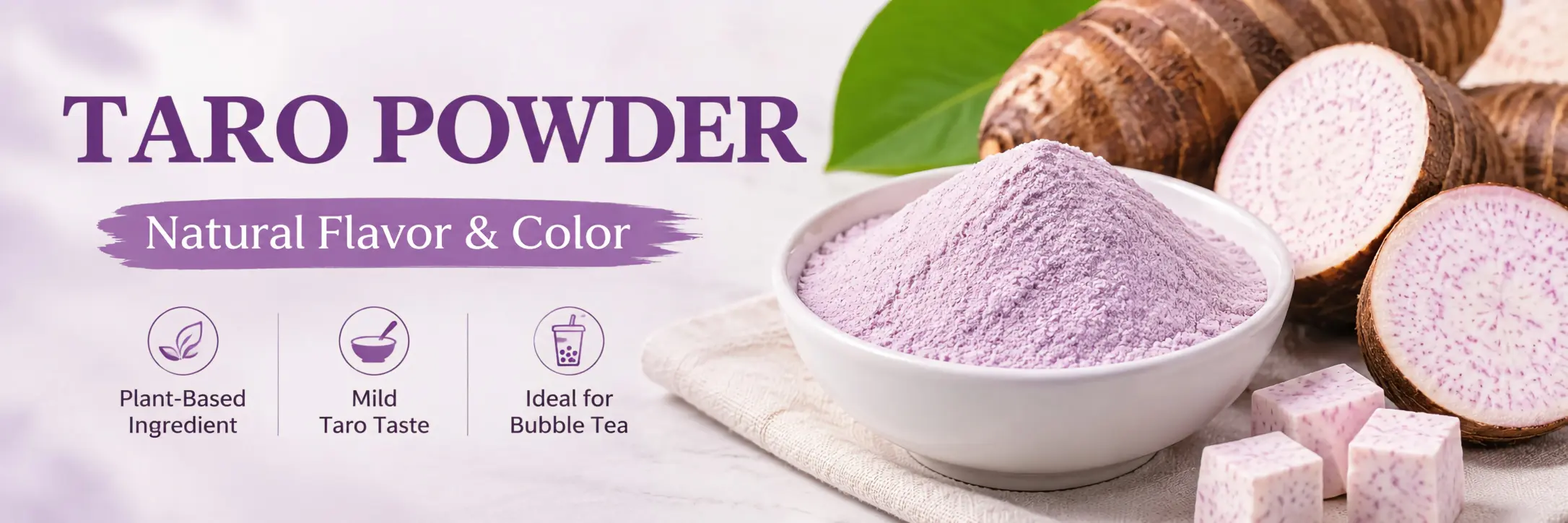
Taro powder is produced from the edible corm of Colocasia esculenta, a tropical plant widely cultivated in Asia, Africa, and the Pacific.
Taro has a mild, earthy, slightly nutty flavor and contains substantial starch. When properly processed, it can contribute body and characteristic root flavor to food and beverage formulations.
For commercial applications, the term “taro powder” may refer to different products:
Pure taro powder: A processed, dried taro ingredient without intentionally added sweeteners or creamers.
Taro-flavored beverage powder: A formulated ingredient containing taro and potentially other components.
Taro milk tea premix: A ready-to-use blend that may contain sweeteners, creamers, flavorings, stabilizers, and coloring ingredients.
These products are not interchangeable.
Manufacturers should always examine the complete ingredient specification rather than relying solely on the product name.
One of the first purchasing decisions is whether to use pure taro powder or a finished beverage premix.
| Factor | Pure Taro Powder | Taro Milk Tea Premix |
|---|---|---|
| Composition | Primarily processed taro | Multiple formulated ingredients |
| Sweetness | Controlled separately | Often predetermined |
| Creaminess | Requires formulation | May contain creamer |
| Color | Typically pale cream to light lavender-gray | Depends on added ingredients |
| Customization | Greater flexibility | Depends on premix supplier |
| Preparation | May require additional processing | Often designed for convenient mixing |
| Ideal buyer | Beverage manufacturers and OEM developers | Cafés and standardized drink operations |
For manufacturers developing private-label beverages, pure taro powder can provide more control over sweetness, flavor intensity, ingredient selection, and nutritional positioning.
Premixes can reduce preparation steps, but they may limit flexibility when brands need to adjust sugar content, dairy ingredients, or color systems.
B2B recommendation: Choose the ingredient format based on your manufacturing model, not simply its price per kilogram.
Natural color
Authentic taro is not necessarily bright purple.
Depending on the variety and processing method, taro flesh may appear white, cream-colored, or lightly speckled with purple. The resulting powder can have a pale beige, grayish, or subtle lavender appearance.
Many brightly purple commercial taro milk teas obtain their appearance from additional coloring ingredients.
Therefore, a stronger purple color does not automatically indicate higher taro content or better quality.
Characteristic flavor
Good taro powder should have a recognizable, mild root flavor without undesirable burnt, stale, or excessively bitter notes.
The final sensory profile depends on the raw material, processing conditions, and beverage formulation.
Appropriate particle size
Particle size affects mixing, mouthfeel, and sedimentation.
A fine powder may be easier to disperse, but finer particles do not guarantee complete dissolution.
Manufacturers should request particle-size specifications and evaluate performance in their intended beverage system.
Batch consistency
Commercial manufacturers need consistent appearance, flavor, moisture, and functional properties across production batches.
This is particularly important for OEM beverage brands supplying multiple markets.
One of the most common mistakes in taro powder sourcing is assuming that every fine powder is water-soluble.
Taro naturally contains starch, which does not behave like sugar or a fully soluble instant tea extract.
Depending on the processing method, taro powder may form a suspension, absorb water, thicken, or leave sediment.
Research on taro powders has shown that maturity and drying methods can affect water absorption, gelatinization, and other functional properties.
For bubble tea manufacturers, these characteristics influence:
Mixing performance
Mouthfeel
Beverage thickness
Sedimentation
Processing requirements
Consistency between servings
When selecting taro powder, ask whether it is raw, pre-cooked, pregelatinized, or otherwise processed for beverage applications.
A raw starch-rich powder may require adequate cooking, while a properly processed instant-use ingredient may be more suitable for convenient beverage preparation.
The key question is not simply “Does it dissolve?” but “Does it perform consistently in our finished drink?”
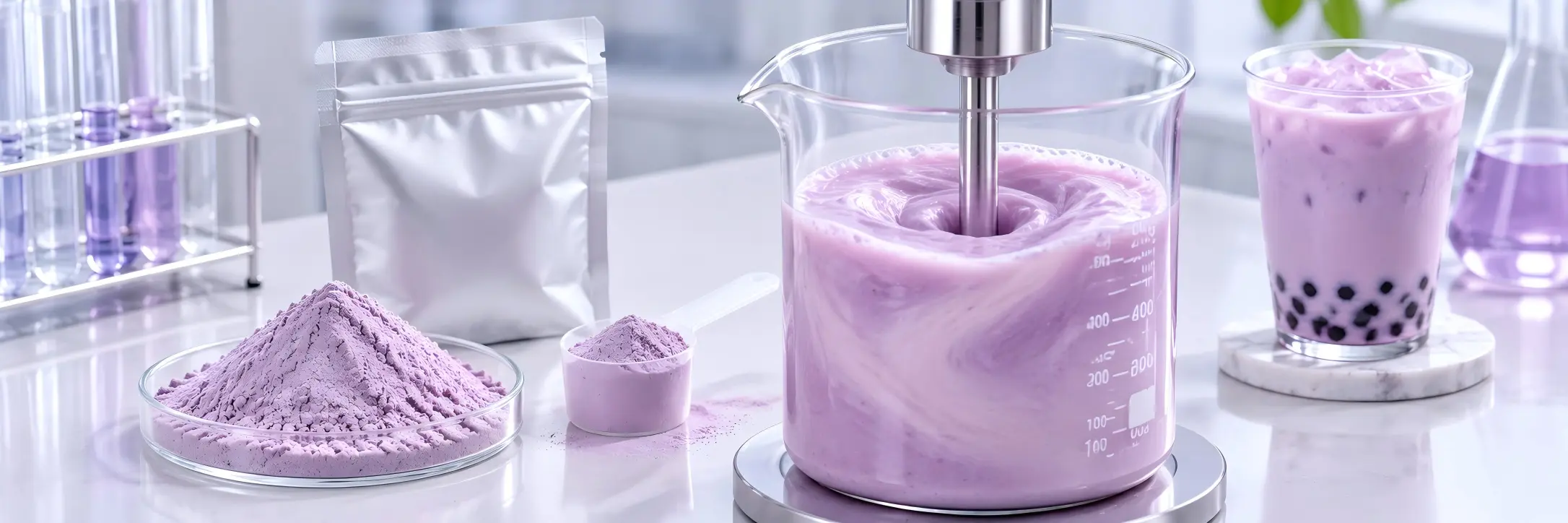
Taro is valued for its relatively mild flavor.
Unlike strongly acidic fruit ingredients or intensely flavored botanical extracts, taro can work well with creamy beverage bases.
However, pure taro powder should not be expected to reproduce the sweet, vanilla-like flavor of every commercial taro milk tea.
That familiar flavor may come from a combination of taro, sugar, dairy or non-dairy creamer, and additional flavoring ingredients.
Manufacturers should evaluate taro powder in the complete formulation, including:
Milk-based bubble tea: Check how the powder interacts with milk proteins, fat, and sweeteners.
Plant-based milk tea: Evaluate flavor and texture in oat, soy, coconut, or other plant-based systems.
Instant bubble tea powder: Test dispersion, powder stability, and preparation convenience.
Frozen beverages: Evaluate texture and flavor after blending with ice.
The ideal taro ingredient should support the intended flavor profile without introducing unwanted graininess or excessive starchiness.
Color is an important commercial consideration because many consumers associate taro milk tea with a lavender-purple appearance.
However, natural taro powder may not produce that color on its own.
Manufacturers have several formulation options.
They can retain the naturally pale appearance of taro, create a subtle lavender shade, or develop a more distinctive purple beverage using an appropriate color ingredient.
Purple sweet potato-derived ingredients may be considered for certain color applications, depending on their composition and regulatory suitability.
The critical point is to distinguish the ingredient providing taro flavor from the ingredient providing color.
For international markets, verify that any added color is permitted for the intended food category and destination country.
Color performance should also be tested after dilution with milk, processing, and storage.
A structured sample evaluation is more reliable than choosing a supplier based on photographs or product descriptions.
Consider the following trial procedure.
Step 1: Establish a reference formula
Use the same tea base, milk or creamer, sweetener, water volume, and preparation conditions for every sample.
Step 2: Compare ingredient grades
Test the candidate taro powders at appropriate inclusion levels. If the products have different compositions, adjust the trials to allow a meaningful comparison.
Step 3: Evaluate sensory performance
Assess taro flavor, sweetness balance, mouthfeel, graininess, and aftertaste.
Step 4: Observe physical stability
Record visible sediment, separation, viscosity changes, and performance at the intended serving temperature.
Step 5: Repeat after processing
For manufactured beverages, test the ingredient after the actual production process rather than relying only on laboratory mixing.
Step 6: Review batch documentation
Compare specifications and COAs to confirm whether the ingredient meets purchasing requirements.
This process helps identify the best-performing ingredient before committing to commercial volumes.
Before placing a bulk order, request a technical specification sheet covering the parameters relevant to your product.
| Specification | Why It Matters |
|---|---|
| Botanical identity | Confirms the raw material |
| Ingredient composition | Distinguishes pure powder from premix |
| Processing method | Helps predict beverage performance |
| Particle size | Influences dispersion and texture |
| Moisture content | Relevant to storage and powder quality |
| Microbiological limits | Supports food safety evaluation |
| Heavy metal testing | Supports contaminant assessment |
| Allergen information | Important for labeling and compliance |
| Shelf life and packaging | Supports inventory planning |
| COA | Provides batch-specific quality information |
Buyers should also ask about minimum order quantity, sample availability, lead time, and packaging options.
For large-scale production, consistent supply is often more valuable than a small difference in the initial quotation.
For bubble tea brands and OEM manufacturers, sourcing taro powder involves more than selecting a powder with an attractive appearance.
The ingredient must fit the intended formulation, processing method, quality requirements, and commercial production plan.
Hunan MT Health Inc. supplies botanical and food ingredient solutions for international B2B customers.
For manufacturers evaluating Taro Powder, our team can discuss ingredient specifications, sample requirements, packaging options, and sourcing needs.
Whether you are developing a new taro milk tea product or reviewing an existing formulation, start by defining the required flavor, color, texture, and preparation method.
Contact Hunan MT Health Inc. to discuss Taro Powder samples and bulk sourcing for your beverage project.
Website: www.instant-tea-powder.com
Email: marketing@mthealth.com.cn
What is the best taro powder for bubble tea?
The best choice depends on the manufacturing application. Pure taro powder offers greater control over the finished formulation, while a premix may simplify preparation. Buyers should compare flavor, dispersion, texture, documentation, and cost per serving.
Is real taro powder naturally purple?
Not necessarily. Real taro powder is often cream-colored, beige, or lightly grayish-lavender. Bright purple bubble tea may contain additional coloring ingredients.
Does taro powder dissolve completely in water?
Not always. Taro contains starch and may disperse or form a suspension rather than dissolve completely. Processing methods affect its behavior.
Can pure taro powder be used in instant milk tea?
Yes, provided the powder has been appropriately processed and validated for the intended preparation method. Raw taro flour and instant-use taro ingredients should not be treated as equivalent.
What is the difference between taro powder and ube powder?
Taro comes from Colocasia esculenta, while ube is purple yam, Dioscorea alata. They have different botanical identities, flavor characteristics, and color properties.
Can bubble tea manufacturers request customized taro powder specifications?
Manufacturers can discuss particle size, ingredient composition, packaging, and application requirements with their supplier. Actual customization availability should be confirmed before ordering.
The best taro powder for bubble tea manufacturers is not necessarily the brightest purple, the finest powder, or the cheapest ingredient.
It is the product that delivers consistent flavor, suitable texture, reliable processing performance, documented quality, and competitive cost per finished serving.
By comparing ingredient composition, dispersion, color, sensory performance, and supply consistency, beverage manufacturers can make better sourcing decisions and develop taro milk tea products suited to their target markets.
15874196392
No. A6-608 Lugu International Industrial Park, Yuelu District, Changsha 410205, Hunan, P.R China



 FR
 EN
 DE
 ES
 RU
 TH
 JA
 KO
 AR
 PT
 ZH