15874196392
湖南省长沙市岳麓区麓谷国际工业园 A6-608 号 邮编:410205
Red is one of the most recognizable colors in food and beverage products. It can signal fruit flavor, sweetness, freshness, energy, or indulgence within seconds. For decades, synthetic colors have helped manufacturers achieve bright and consistent red shades at relatively low cost.
But in 2026, the conversation around food color is changing.
Food manufacturers are increasingly exploring natural red food colors as consumers pay closer attention to ingredient labels, brands reformulate products, and regulators create new momentum around alternatives to certain synthetic color additives. In the United States, the FDA has taken several steps to support the transition toward naturally derived colors, including actions involving beetroot red and labeling claims related to the absence of artificial colors.
At the same time, replacing synthetic red with a natural ingredient is not simply a one-for-one substitution. Natural pigments behave differently depending on pH, heat, oxygen, light, water activity, processing conditions, and the food matrix.
So why are natural red food colors trending in 2026—and what should product developers know before choosing one?
One of the strongest drivers behind the natural color trend is the growing pressure to reduce the use of artificial colors.
In the U.S., the FDA revoked authorization for FD&C Red No. 3 in January 2025 and has encouraged industry to move away from several remaining certified colors. The agency has also been working with manufacturers and other stakeholders on alternatives and has approved new natural color options, including beetroot red, although the effective date of the beetroot red order was subsequently delayed while objections were evaluated.
This regulatory movement is occurring alongside changes in consumer demand.
A 2026 analysis by RTI International, commissioned by the National Confectioners Association, reported that products carrying “natural colors” on their labels saw 24.4% dollar-sales growth from 2024 to 2025, compared with 0.1% growth for products listing artificial colors. The analysis covered food and beverage products across multiple categories.
The numbers should not be interpreted as proof that natural colors are inherently healthier. They are better understood as evidence of a market shift in formulation and consumer purchasing behavior.
For food brands, color is becoming part of the ingredient story.
Natural food coloring is not a single technology.
Different pigments produce different shades and respond differently to processing conditions. This becomes particularly important when manufacturers try to create a stable natural red.
Common natural sources include:
Beetroot – betalain-based red to reddish-purple shades
Purple sweet potato – anthocyanin-based red, purple, and pink shades
Black carrot – anthocyanin-rich red to purple shades
Red radish – anthocyanin-based reddish-pink colors
Grape or berry sources – anthocyanin-based colors
Paprika – carotenoid-based orange-red shades
Lycopene – tomato-derived orange-red shades
The challenge is that these pigments are not interchangeable.
A natural color that performs well in an acidic beverage may behave differently in a bakery product, dairy formulation, confectionery application, or high-temperature process.
A recent 2026 review of natural food colorants emphasized that pigment performance is strongly influenced by factors such as pH, oxygen, temperature, light, metals, formulation composition, processing intensity, and storage conditions.
This is why the future of natural red food coloring is not simply about finding “the reddest” ingredient.
It is about finding the right color for the right application.
Among natural red ingredients, beetroot is particularly interesting because its characteristic color comes from betalain pigments, especially the red-violet betacyanin group.
Beetroot-derived color has been used in food applications for many years. Beetroot red can provide pink, red, or reddish-purple tones depending on formulation and concentration.
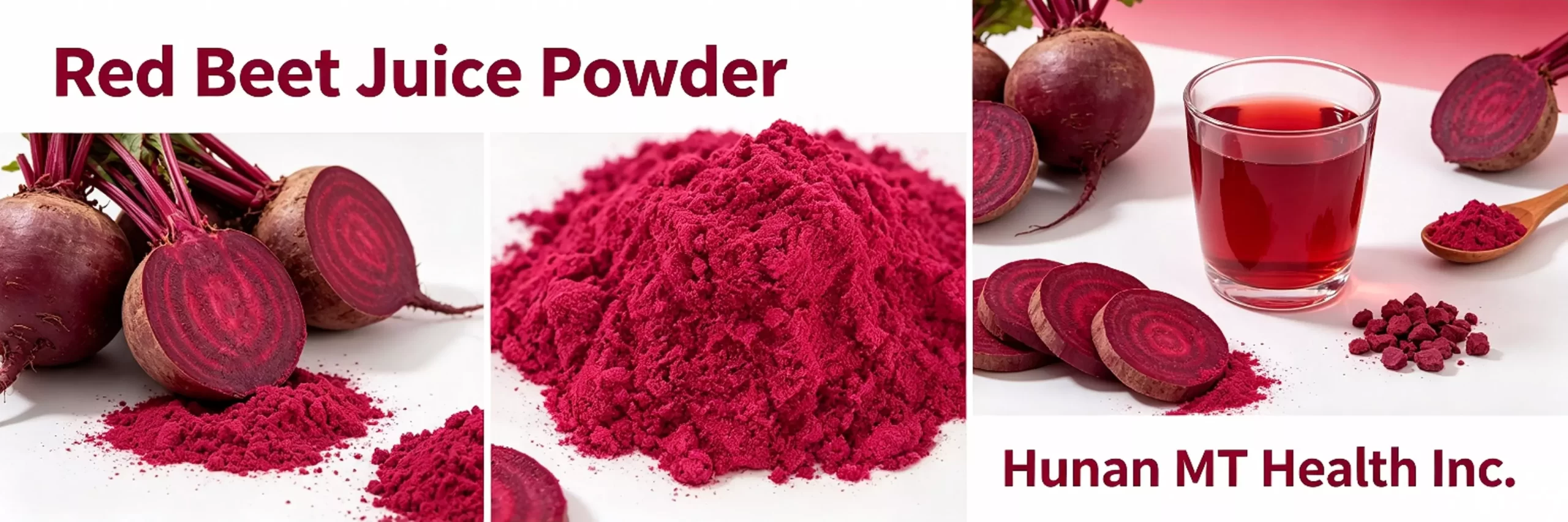
For food manufacturers, 红甜菜汁粉 offers another practical format for incorporating beet-derived color into dry formulations.
It can be considered for applications such as:
Beverage powders
Smoothie and nutrition mixes
Bakery products
Desserts
Confectionery
Snack formulations
Dairy and plant-based products
Dry food mixes
Food premixes
However, the exact performance depends on the formulation.
Beetroot pigments are sensitive to processing and storage conditions. Research has shown that factors including temperature, pH, light, oxygen, water activity, and metal ions can influence betalain stability.
That means a good natural red ingredient should not be evaluated only by looking at the powder in its original form.
The more important question is:
How will the color perform in the finished product?
This is one of the most important points for B2B buyers.
A food manufacturer may initially ask for “a natural red color,” but that specification is incomplete.
A beverage manufacturer may need a different color system from a bakery producer. A low-pH fruit drink may provide a very different environment from a neutral dairy product. A product exposed to baking temperatures has different requirements from a powdered beverage mixed shortly before consumption.
For example, anthocyanin-based colors can be particularly useful in acidic systems, while their color behavior can change as pH increases. Beetroot betalains have their own stability profile and can be affected by heat and oxidation. Carotenoid-based colors such as paprika and lycopene behave differently again.
This is why modern natural color development is becoming increasingly application-driven rather than ingredient-driven.
Instead of asking:
“Which natural red is the strongest?”
Product developers should ask:
“Which natural red provides the required shade and performance under our processing and storage conditions?”
That small change in thinking can significantly improve formulation decisions.
For many years, food manufacturers primarily evaluated colorants based on three factors:
Color intensity.
Consistency.
Cost.
These factors still matter.
But in 2026, another factor has become increasingly important: ingredient transparency.
Consumers are paying greater attention to recognizable ingredient sources and product positioning. Sensient’s 2026 food and beverage trend research identifies transparency and clean-label formulation as important drivers of color innovation, noting that consumers increasingly look for recognizable ingredients while still expecting attractive taste and appearance.
This creates a new formulation challenge.
A natural color needs to satisfy both the technical side and the consumer-facing side of product development.
For example, a brand may want a red beverage that:
Has an attractive natural-looking color
Fits its ingredient positioning
Performs consistently during processing
Maintains acceptable color during shelf life
Works with the target pH
Does not negatively affect flavor
Has appropriate documentation for the intended market
Natural color is therefore no longer just a visual ingredient.
It is increasingly part of the product’s overall formulation strategy.
The popularity of natural red colors does not mean the technical challenges have disappeared.
In fact, stability is one of the biggest reasons why natural red color development remains an active area of food science.
A 2026 industry report highlighted the difficulty of developing a plant-based red that can maintain strong performance under high temperatures and long shelf-life conditions. Natural red pigments may respond differently to baking, extrusion, pasteurization, light exposure, oxygen, and different food matrices.
This explains why a natural red that looks excellent in a laboratory beaker may not produce the same result after commercial processing.
For B2B buyers, application testing is therefore critical.
Important questions include:
Some natural pigments perform better in acidic environments than in neutral or alkaline systems.
Will the product be heated?
Pasteurization, baking, cooking, and extrusion can significantly affect pigment stability.
How long is the expected shelf life?
Color needs to remain commercially acceptable not only immediately after production but also during storage.
Is the product exposed to light?
Light can accelerate pigment degradation in some formulations.
What is the food matrix?
Sugar, protein, fat, minerals, acids, and other ingredients can influence color performance.
The best natural red color is therefore application-specific.
The natural red trend is not limited to replacing synthetic dyes in existing products.
It is also creating opportunities for new product concepts.
Red is closely associated with several popular flavor and product categories, including:
Berry beverages
Natural red and pink shades can complement strawberry, raspberry, cherry, cranberry, and mixed-berry profiles.
Fruit-based snacks
Red colors can reinforce fruit positioning in gummies, bars, fruit snacks, and powdered products.
Bakery and desserts
Natural red ingredients can be explored for cakes, frostings, fillings, cookies, and dessert mixes, subject to processing requirements.
Functional beverages
Bright botanical and fruit-inspired colors can help create visually distinctive beverage concepts.
Plant-based products
Natural color systems are increasingly relevant to brands seeking recognizable ingredient positioning.
This makes natural red food colors more than a reformulation tool.
They can become part of a product’s visual identity and market positioning.
When sourcing Red Beet Juice Powder or other natural red ingredients, the purchasing decision should go beyond price per kilogram.
A reliable evaluation can include the following:
1. Raw Material Identity
Confirm the botanical source and the form of the raw material.
For beet-derived ingredients, clear raw material identification helps establish consistency from batch to batch.
2. Color Specification
Ask how color is measured and reported.
Depending on the product, buyers may need information such as pigment content, color value, appearance, or application-specific test results.
3. Processing Method
Drying and processing conditions can influence the final powder’s performance.
Understanding how the ingredient is produced helps buyers evaluate its suitability for their formulation.
4. Application Testing
Request samples and test them under actual processing conditions.
A small-scale application test can reveal issues that cannot be identified from a product specification sheet alone.
5. Quality Documentation
Depending on the market and application, buyers may need documentation such as:
COA
Microbiological specifications
Heavy metal testing
Pesticide information
Allergen information
Regulatory documentation
Certification documents
6. Supply Consistency
Natural raw materials can vary because of agricultural conditions, harvest periods, geographical origin, and processing.
For large-scale product development, supply consistency is therefore as important as initial color performance.
The natural red trend is being driven by several forces at the same time.
Consumer expectations are increasing interest in recognizable and natural-looking ingredients.
Brand reformulation is creating demand for alternatives to synthetic colors.
Regulatory developments are accelerating conversations around color-additive replacement in major markets.
Food science is developing new approaches to improve the stability and usability of natural pigments.
At the same time, manufacturers are learning that replacing a synthetic red is not simply an ingredient swap.
The future will likely involve more application-specific color systems, better stabilization technologies, improved processing, and closer collaboration between ingredient suppliers and food manufacturers.
In other words, the question is no longer simply:
“Can natural color replace synthetic color?”
The more useful question is:
“How can natural color be formulated to deliver the required appearance, stability, and commercial performance?”
At Hunan MT Health, we understand that B2B buyers need more than a natural-looking powder.
They need an ingredient that can fit into a real product-development process.
Our Red Beet Juice Powder can be considered for food and beverage applications where a beet-derived red color is desired. Depending on the customer’s formulation, our team can support sample evaluation, product specification discussions, and application-oriented sourcing.
For manufacturers developing beverages, bakery products, desserts, food powders, or other naturally positioned products, the development process should start with the final application—not simply the ingredient catalog.
A natural red color is successful when it works from raw material to formulation to finished product.
The Future of Red Is Natural—and Application-Specific
Natural red food colors are trending in 2026 for a reason: the food industry is changing from multiple directions at once.
Consumers are paying more attention to ingredient labels. Brands are reformulating established products. Regulators are creating new pathways and pressures around food colors. Meanwhile, food scientists are working to solve the technical limitations of natural pigments.
But natural does not automatically mean simple.
Red beet, anthocyanins, paprika, lycopene, and other natural color sources each have different strengths and limitations. Their performance depends on the food matrix, processing conditions, pH, storage, and target shelf life.
For B2B food manufacturers, the winning approach is not simply to find a “natural red.”
It is to find the right natural red for the right application, supported by reliable specifications, testing, documentation, and supply.
That is where natural color moves from a trend into a practical product-development strategy.
15874196392
湖南省长沙市岳麓区麓谷国际工业园 A6-608 号 邮编:410205



 ZH
ZH  EN
EN  FR
FR  DE
DE  ES
ES  RU
RU  TH
TH  JA
JA  KO
KO  AR
AR  PT
PT