15874196392
湖南省长沙市岳麓区麓谷国际工业园 A6-608 号 邮编:410205
If you are a beverage brand owner, functional drink manufacturer, ingredient formulator, or sourcing manager looking for bulk instant tea powder for commercial production, this guide is designed to help you make safer, more cost-effective purchasing decisions.
Instant tea powder is one of the most widely used ingredients in the global beverage industry. It appears in ready-to-drink teas, iced tea drinks, milk tea bases, functional beverages, powdered drink mixes, and even some cosmetic and nutritional formulations. However, because many buyers evaluate suppliers mainly on price and appearance, low-quality raw materials often enter the supply chain without being detected until production or customs inspection.
The risks of choosing substandard instant tea powder are real. They include inconsistent flavor, poor cold-water solubility, unexpected color variation, high moisture content, microbiological instability, heavy metal contamination, pesticide residue non-compliance, and even shipment rejection at the destination port. For manufacturers, these problems can cause production delays, reformulation costs, customer complaints, brand damage, and in serious cases, product recalls.
This purchasing guide explains the most important checkpoints for selecting reliable bulk instant tea powder suppliers. It is based on practical quality control requirements commonly seen in international food and beverage sourcing, including EU, FDA, and general food safety expectations.
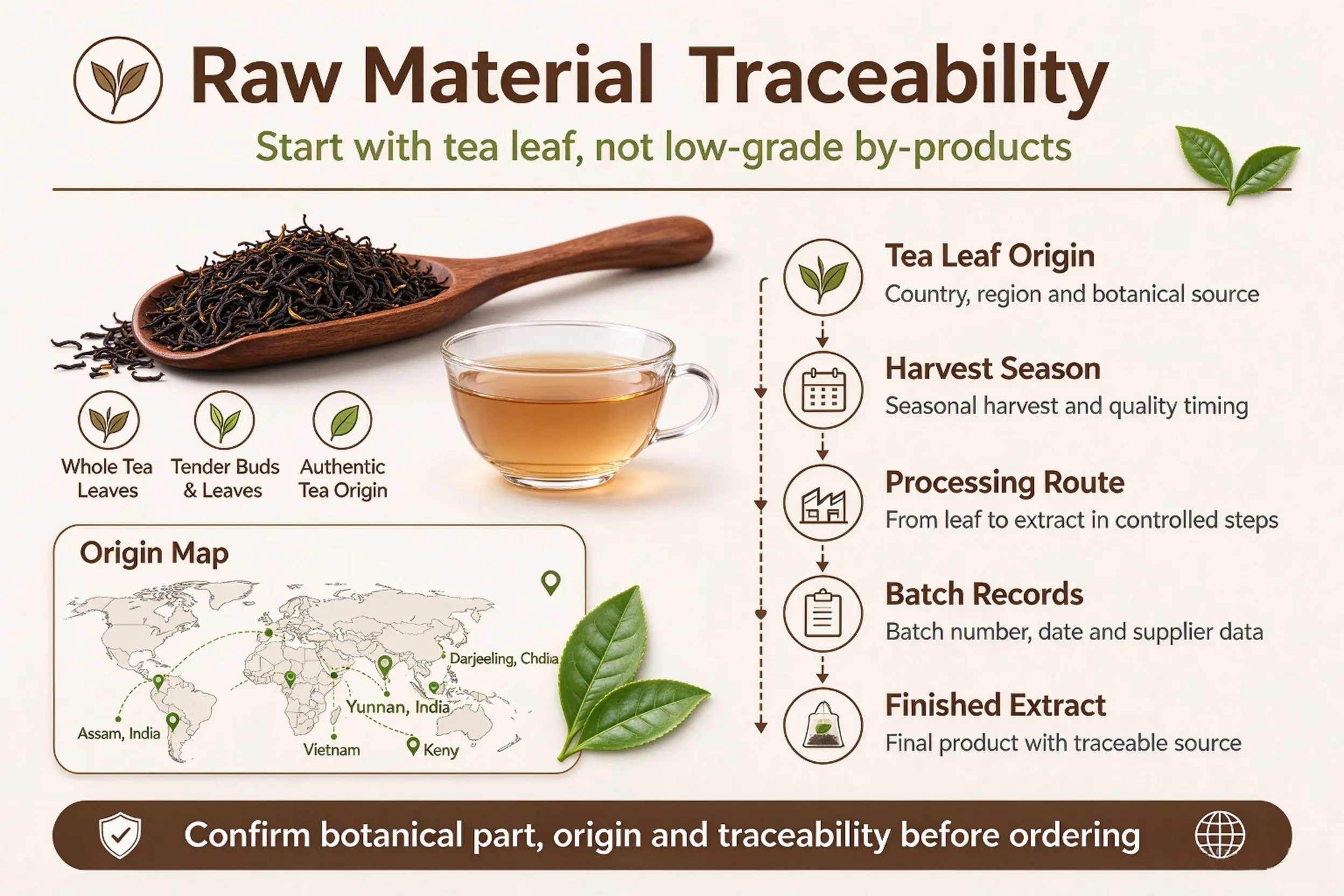
The first and most fundamental question is: What is the raw material source of the instant tea powder?
High-quality instant tea powder is normally produced from fresh tea leaves through water extraction, concentration, and drying. Tea leaves contain the characteristic polyphenols, catechins, theaflavins, and aroma compounds that give tea its typical flavor and functional properties. When the raw material is consistent, the finished powder is more likely to deliver stable taste, color, and performance from batch to batch.
Low-quality instant tea powder, however, is sometimes made from tea dust, fannings, stalk scraps, or leftover by-products that have weaker flavor and higher impurity levels. These materials may still look like tea powder, but they often lack consistent active content. They can also introduce more impurities, off-notes, and processing challenges, especially when used in premium beverage formulas.
When evaluating a supplier, ask these questions in writing:
Where are the tea leaves sourced from?
Is the raw material whole tea leaf, or a mixture of leaf, stalk, and dust?
Can the supplier provide origin information and harvest season records?
Does the factory have traceability from raw tea to finished extract?
For international beverage manufacturers, raw material traceability is not just a quality issue—it is also a regulatory and brand risk issue. Buyers should prefer suppliers that can clearly define the botanical part, origin, and processing route of the instant tea powder.
Many new buyers make the same mistake: they receive a sample of instant tea powder, see that it is brown, and assume the quality is acceptable. But color alone cannot tell you whether the product meets your formulation requirements.
Commercial-grade instant tea powder should come with a clear specification sheet. This document is the basis for contractual purchasing. Without written specifications, it is difficult to prove non-conformity or make a claim if the bulk shipment does not match your expectation.
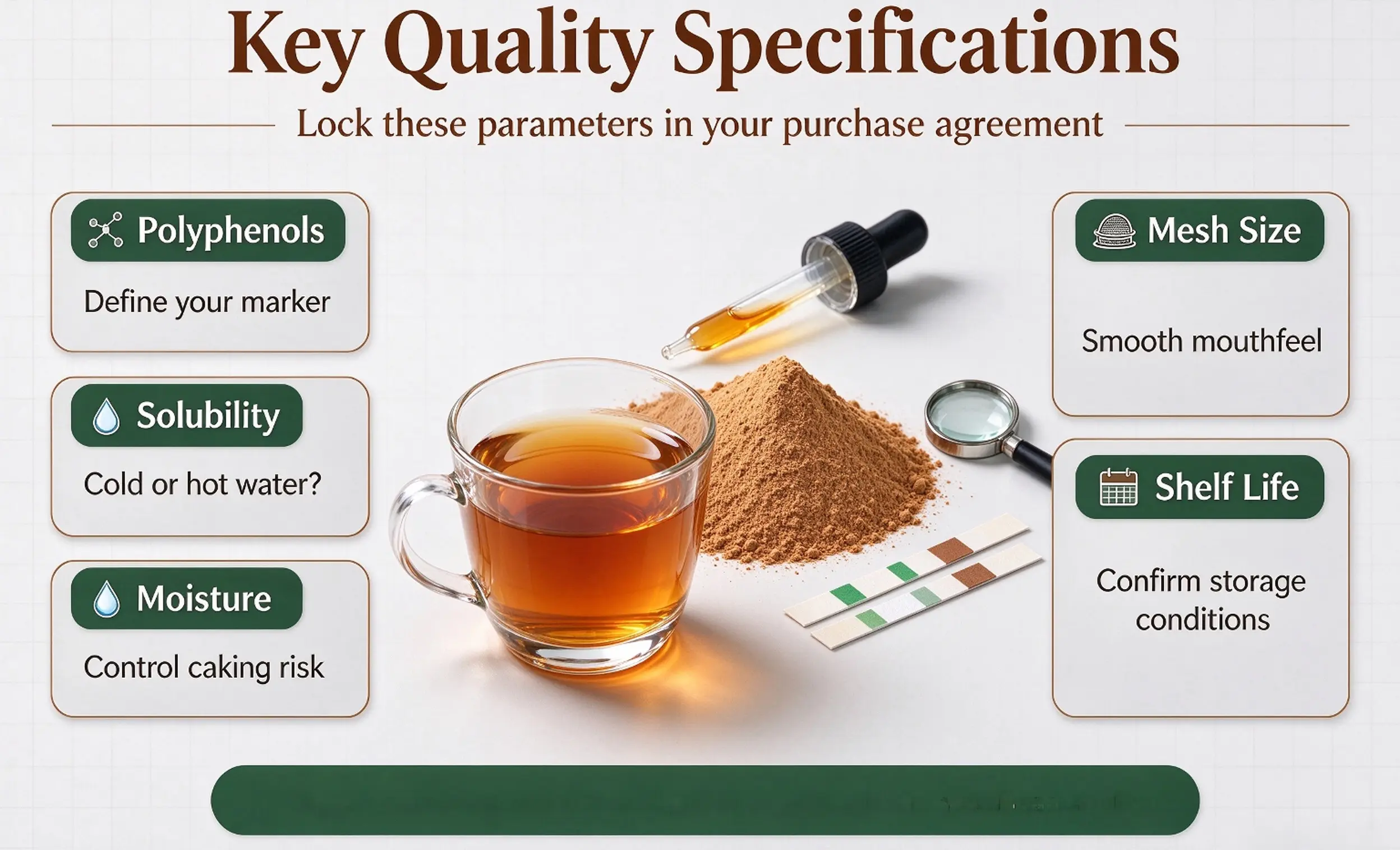
Key specifications to confirm include:
外观
Instant black tea powder is typically a brown-red or brown powder. The color should be reasonably uniform within the same brand and grade. However, buyers should remember that natural raw materials can show slight batch-to-batch variation. The important thing is whether the supplier controls this variation within an acceptable range.
Polyphenol Content
Polyphenols are among the most important active markers in tea extract. They are related to tea’s characteristic bitterness, astringency, antioxidant properties, and overall flavor profile.
For beverage-grade instant tea powder, a common specification might be 30% polyphenols, but different grades exist depending on the application. Some products are standardized for polyphenols, while others are traded more loosely as general instant tea solids. Buyers should clarify what “active content” means in their contract.
可溶性
Solubility is especially important for beverage manufacturers. Instant tea powder may be designed for cold water, hot water, or both. If your product is an iced tea or ready-to-drink beverage, poor cold-water solubility can create sediment, cloudiness, or residue that consumers notice immediately.
When testing samples, evaluate:
How quickly the powder disperses in water
Whether undissolved clumps remain
Whether sediment forms after standing
Whether the color and taste are uniform
水分含量
Moisture is a critical stability parameter. High moisture increases the risk of caking, microbial growth, and shorter shelf life. For many dry food ingredients, lower moisture is generally better, as long as it is within the supplier’s controlled specification.
网眼尺寸
Mesh size affects mouthfeel and dispersion. A fine, uniform particle size usually gives a smoother drinking experience. If the powder is too coarse or contains gritty particles, it may leave a residue in the mouth or affect the clarity of the finished beverage.
Shelf Life and Storage Conditions
Finally, confirm the shelf life and storage instructions. Most bulk instant tea powder products should be stored in a cool, dry place, away from direct sunlight and moisture. If the supplier cannot provide clear storage guidance, it is a warning sign about quality control maturity.
Heavy metal contamination is one of the most serious risks in plant-based ingredient sourcing. For bulk instant tea powder, the key heavy metals to check are:
Arsenic
Lead
Cadmium
Mercury
Tea plants can absorb heavy metals from soil, water, and environmental contamination. If the raw material is grown in areas with high background levels or contaminated water, the finished extract may contain unacceptable residues. Because tea is often consumed in large quantities as a beverage, even moderate levels can become a concern over time.
Different target markets have different regulatory limits. EU food safety standards, FDA-related requirements, and other national food regulations may apply depending on where your product is sold. Buyers should not assume that “food grade” automatically means compliant. Instead, they should ask suppliers for third-party heavy metal test reports and compare the results against the required limits.
When reviewing a heavy metal report, check:
The sample identification information
The test date
The laboratory name or accreditation information
The detection limits for each element
Whether results are below the applicable limits
A reliable supplier should be able to provide heavy metal data for instant tea powder without excessive delay. If a supplier cannot provide this information, or if the report is incomplete, buyers should treat that as a major risk signal.
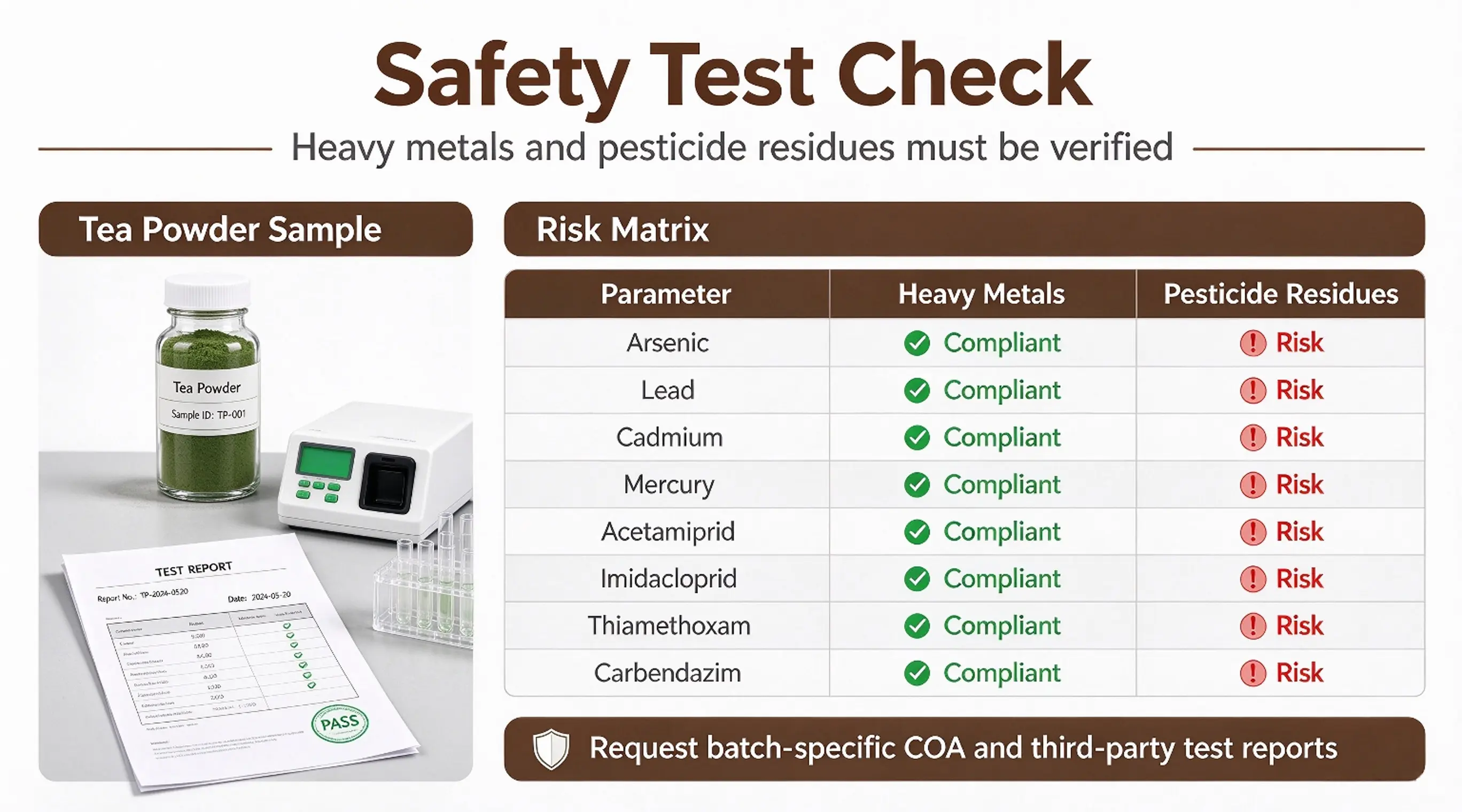
Pesticide residue non-compliance is one of the leading causes of ingredient rejection at customs, especially for plant-derived ingredients imported into the EU, USA, and other regulated markets. Many beverage manufacturers have learned this the hard way: a full container of bulk instant tea powder can be detained or destroyed if even one pesticide exceeds the allowed limit.
For this reason, pesticide residue screening is not optional—it is a mandatory part of responsible sourcing.
When evaluating pesticide reports, buyers should check:
The Number of Pesticides Screened
A basic pesticide report should cover a meaningful list of common agricultural chemicals. For tea, important residues may include acetamiprid, imidacloprid, thiamethoxam, carbendazim, and other insecticides or fungicides used in crop protection. The more comprehensive the screening, the lower the risk of unexpected non-compliance.
The Test Method
Different test methods have different scopes and detection limits. Suppliers should provide reports that use internationally recognized methods suitable for the destination market. Common references include BS EN 15662 and similar multi-pesticide screening standards.
The LOQ and Actual Results
LOQ means Limit of Quantitation. A result like “Not Detected” or “Below LOQ” is better than an uncertain result. Buyers should also check whether the reported values are close to the maximum allowed limits. Even if a result is technically within the limit, a very high value may indicate weak control at the farm or raw material level.
Batch Traceability
Pesticide residue reports must be linked to a specific batch. A one-time report from three years ago does not guarantee that your current shipment is safe. Buyers should request the most recent report and confirm that it matches the batch or batches being ordered.
A professional bulk instant tea powder supplier should be able to provide a complete set of commercial and compliance documents. These are not just “papers”—they are part of your import, quality assurance, and customer audit process.
At minimum, buyers should request:
COA (Certificate of Analysis)
The COA is the most important document for each shipment. It should show the actual test results of the specific batch you are purchasing, including appearance, active content, moisture, heavy metals, and microbiological parameters.
Pesticide Residue Report
As explained above, this report confirms that the batch has been screened for common pesticides. For export markets, this is often essential for customs clearance and food safety compliance.
Third-Party Lab Reports
Independent lab reports carry more weight than internal supplier reports alone. When possible, buyers should prefer suppliers that use recognized third-party laboratories for key safety tests.
Product Specification Sheet
This document defines the quality standard of the product and should form part of your purchase agreement.
Halal / Kosher (If Applicable)
If your product is sold in Halal- or Kosher-sensitive markets, you will need valid certificates. Do not assume that a generic statement is enough; check the certificate scope, issue date, and validity period.
ISO, GMP, and Other Management Certificates
Certificates such as ISO 9001, ISO 22000, and cGMP indicate that the supplier has established certain quality management systems. They are not proof that every batch is perfect, but they are useful indicators of overall factory capability.
Organic Certificate (If Applicable)
If you are buying organic instant tea powder, the organic certificate must cover the product category, origin, and certification body. Fake or misused organic certificates are a real risk in the ingredient trade.
Commercial Documents
Commercial invoice, packing list, bill of lading, and certificate of origin are essential for import clearance. Missing or incorrect documents can cause unexpected delays at the port.

Many companies sell bulk instant tea powder, but not all of them control the manufacturing process. Some are traders with limited quality control ability, while others are actual manufacturers with extraction, concentration, drying, testing, and packaging capabilities.
When possible, buyers should evaluate the supplier’s factory strength. Key questions include:
Does the supplier own the production facility, or is it reselling from other factories?
Can the factory perform extraction, concentration, and drying in-house?
Does it have an internal laboratory for basic testing?
Does it keep batch records for raw materials, processing, testing, and packaging?
Can it provide sample retention and traceability records?
Does it have a system for handling customer complaints, deviations, and rejections?
A factory with strong internal control is more likely to deliver consistent instant tea powder. It is also better able to respond if a quality issue occurs. For long-term beverage supply partnerships, this stability matters more than the lowest price.
Even if a supplier provides attractive documents, buyers should still test the actual sample before placing a large order. This is one of the most effective ways to reduce raw material risk.
A sample evaluation should cover at least three areas:
Laboratory Verification
Send the sample to an independent lab to confirm:
Polyphenol or marker content
Heavy metal levels
Pesticide residue status
Moisture content
Microbiological quality
Formulation Testing
Test the ingredient in your own beverage system. Check:
Dispersion speed
Clarity or turbidity
Color stability
Taste profile
Sediment formation
Interaction with other ingredients
Storage and Stability Screening
If possible, run a small stability test. A good instant tea powder should remain dry, free-flowing, and stable under proper storage conditions. Caking, clumping, color change, or bad odor are clear warning signs.
If the sample passes all these checks, you can proceed to bulk ordering with more confidence. If it fails, you have saved yourself from a much more expensive problem later.
Quality does not end at the factory gate. Poor packaging and transportation can damage even the best instant tea powder.
Packaging Requirements
Most bulk food ingredients are packed in fiber drums with inner plastic bags. The packaging should be clean, dry, well-sealed, and clearly labeled. Labels should include product name, batch number, net weight, manufacturer information, storage conditions, and expiry date.
Shipping Conditions
The shipment should be kept dry and protected from moisture. If the container is exposed to rain, high humidity, or poor ventilation, the powder may absorb water and become caked. Buyers should confirm that the supplier uses proper sealing and container protection.
Warehouse Storage
Once the goods arrive at your factory or warehouse, store them according to the supplier’s instructions. Recommended conditions typically include:
Cool and dry area
Sealed packaging
Away from direct sunlight
Away from strong odors or chemically incompatible materials
Separate storage for non-conforming or quarantined batches
By controlling storage conditions, you protect both the physical quality and the regulatory status of your bulk instant tea powder.
When sourcing instant tea powder, watch for these red flags:
The supplier provides only one old test report for all products.
No batch-specific COA is available.
Pesticide residue screening is incomplete or missing.
The product is extremely cheap compared to market averages.
The supplier cannot explain the raw material origin or manufacturing process.
Specifications are vague or changed without notice.
Packaging labels are incomplete or inconsistent with documents.
Sample results differ significantly from the bulk shipment.
If you see any of these signs, pause the purchasing process and ask for clarification. It is better to spend extra time verifying the supplier now than to solve a major quality problem later.
The best bulk instant tea powder sourcing strategy is not just about finding the lowest price—it is about finding a supplier you can rely on.
A reliable supplier will:
Provide clear specifications
Support sample testing
Issue batch-specific COAs
Keep records traceable
Communicate problems early
Maintain consistent manufacturing standards
Help you solve formulation or quality issues
Long-term partnerships reduce re-testing costs, lower supply uncertainty, and make it easier to manage quality across multiple production cycles. For beverage manufacturers, this stability is extremely valuable.
Final Checklist for Bulk Instant Tea Powder Purchasing
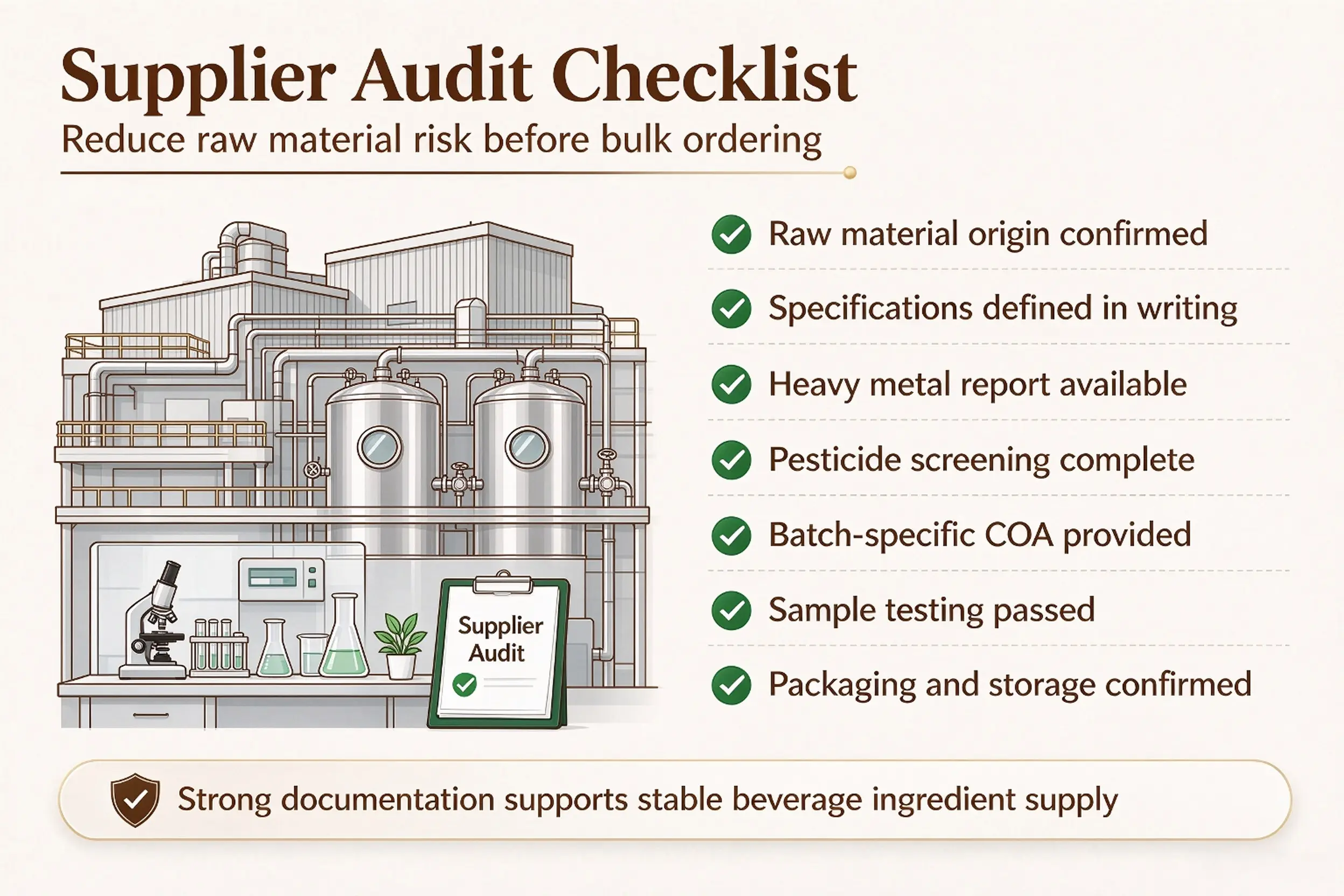
Before placing your next order, use this checklist:
Raw material origin and botanical part are confirmed
Product specifications are clearly defined
Polyphenol or marker content is verified
Solubility meets your formulation requirement
Moisture and mesh size are acceptable
Heavy metal test report is available
Pesticide residue screening is complete
COA is batch-specific
Factory documents and certificates are valid
Sample testing is completed before bulk order
Packaging and storage conditions are confirmed
Bulk instant tea powder may look like a simple ingredient, but it carries significant quality, safety, and regulatory risks. For beverage manufacturers, the cost of choosing low-quality raw materials is much higher than the small savings from a cheaper supplier.
The most effective purchasing strategy is to focus on real data, traceability, documentation, and supplier capability. Start with the raw material source, confirm specifications in writing, verify heavy metals and pesticide residues, review all certificates, test the sample, and protect the product through proper packaging and storage.
By following these steps, you can reduce raw material risks, improve batch consistency, protect your brand, and build a more stable supply chain for instant tea powder in beverage production.
15874196392
湖南省长沙市岳麓区麓谷国际工业园 A6-608 号 邮编:410205



 ZH
ZH  EN
EN  FR
FR  DE
DE  ES
ES  RU
RU  TH
TH  JA
JA  KO
KO  AR
AR  PT
PT