15874196392
No. A6-608 Lugu International Industrial Park, Yuelu District, Changsha 410205, Hunan, P.R China
As clean‑label, zero‑sugar consumer demand keeps growing, more instant‑tea and instant milk‑tea OEM projects adopt stevia powder as a plant‑derived high‑intensity sweetener. It brings zero‑calorie sweetness, matches clean‑label marketing, and fits well with stick‑pack instant tea premix production.
However, one recurring technical complaint from beverage developers is stevia’s unwanted aftertaste: licorice notes, lingering sweetness, subtle bitter or metallic off‑notes that appear after drinking brewed instant milk tea. These sensory defects will directly drag down consumer reviews and repeat purchase rates for your private‑label tea products.
For instant powder‑based tea systems, solving stevia aftertaste cannot rely only on adding extra flavors. The solution covers raw‑material grade selection, sweetener blending ratio, premix formula adjustment, powder processing, and real‑world pilot testing.
This practical guide targets instant tea and milk‑tea powder premix OEM scenarios. It breaks down why stevia aftertaste occurs in powdered‑drink matrices and delivers actionable fixes for formulators and OEM brand buyers.
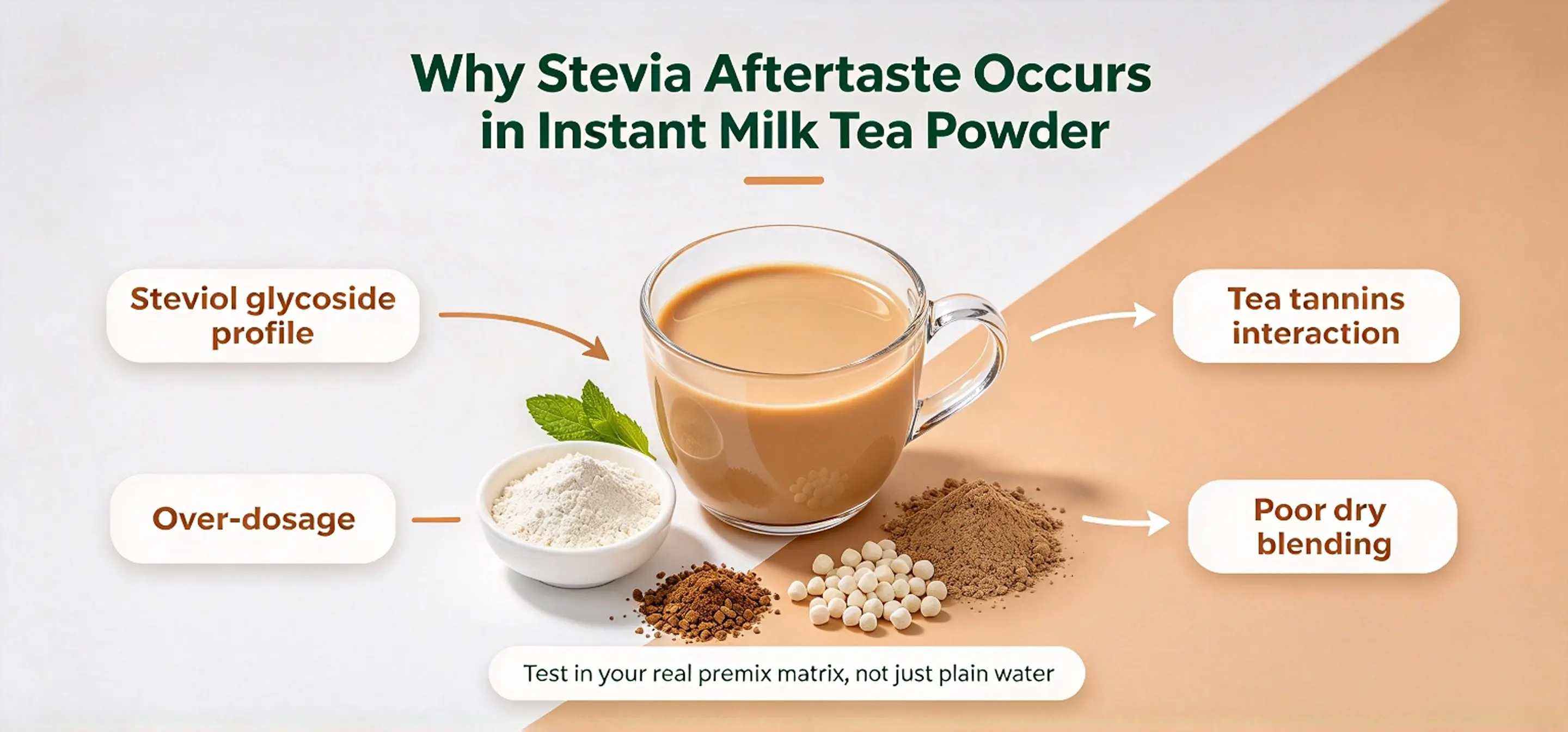
Stevia after‑flavor does not come from a single cause, especially inside complex milk‑tea premixes containing tea polyphenols, creamer, milk solids and other botanical components.
First, steviol glycoside composition determines taste quality. Low‑purity stevia powder contains high stevioside content. Stevioside delivers strong licorice‑like bitterness and lingering sweetness, which becomes very obvious once brewed with hot water in milk‑tea systems. Different Rebaudioside grades (Reb‑A, Reb‑M) perform very differently in powdered‑beverage formulas.
Second, tea tannins and creamer amplify off‑notes. Instant black tea / green tea powder naturally contains polyphenols and tannins. Those compounds interact with stevia glycosides and make bitter or licorice‑like perceptions stronger than in plain water solutions. What tastes acceptable in simple water may taste unpleasant in finished milk‑tea premix.
Third, over‑dosage is a frequent OEM mistake. Since stevia is 200‑400 times sweeter than sucrose, even a small excess addition will trigger obvious lingering after‑flavor in reconstituted drinks. Many formulators over‑add stevia powder trying to reach ideal sweetness, worsening sensory defects.
Fourth, dry‑blending in powder premix may cause local high‑concentration hot‑spots. Poor homogenization during powder mixing creates micro‑zones of concentrated stevia. When consumers brew the stick‑pack, partial high‑stevia areas dissolve and release noticeable off‑taste.
Important note: You cannot judge stevia taste quality purely by testing it in plain water. Always run sensory trials inside your real instant‑tea/milk‑tea base matrix.
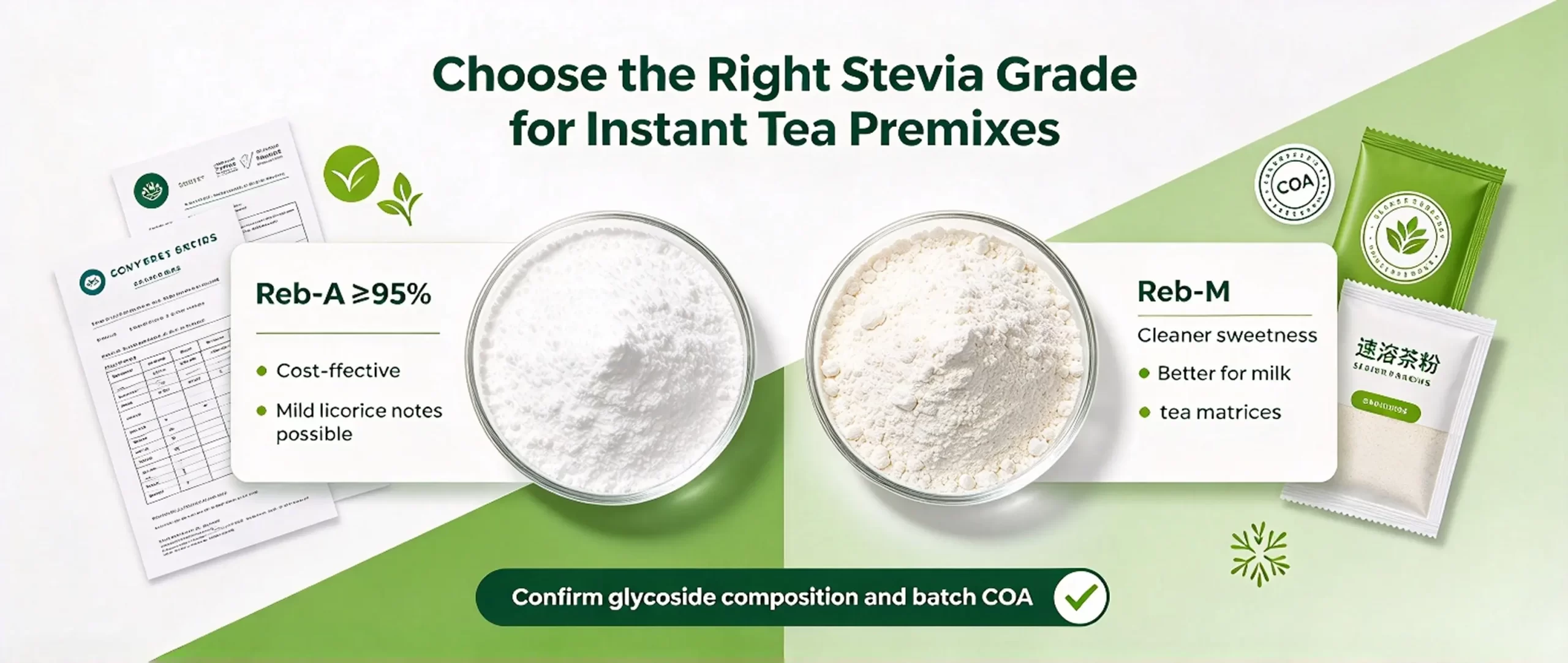
Choosing suitable raw material grade is the most fundamental fix for reducing after‑taste before you adjust your formula.
Reb‑A ≥95%: Cost‑effective option for instant tea. Still shows mild licorice notes at higher dosage. Best for medium‑low sweetness targets in milk‑tea powder. Require suppliers to provide batch‑specific COA confirming glycoside composition, not just total steviol glycoside value.
Reb‑M stevia powder: Premium grade for zero‑sugar milk‑tea OEM. Reb‑M delivers far less licorice, bitter and lingering sweetness compared to Reb‑A, performing much better in creamer‑containing milk‑tea matrices. Reb‑M allows higher usage limits without obvious off‑notes, ideal for high‑end clean‑label private‑label tea lines.
Avoid crude stevia leaf powder or low‑purity stevia extracts for instant milk‑tea premix. These cheap grades contain large stevioside fractions and are not fit for beverage powder applications.
For instant‑tea OEM projects, clearly communicate glycoside requirements to your ingredient supplier. Do not accept generic “stevia powder” without defined Reb‑A / Reb‑M specifications.
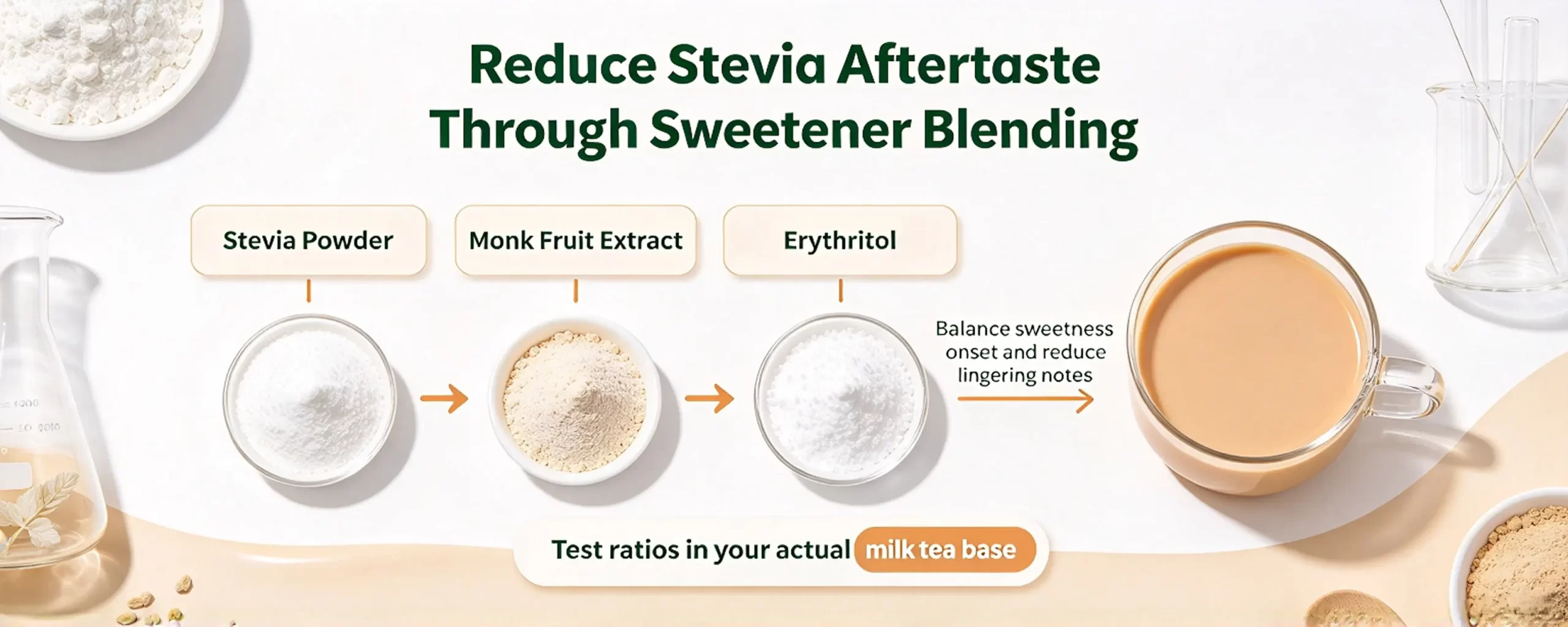
For most instant‑milk‑tea powder projects, using stevia alone rarely delivers sugar‑equivalent clean taste. Blending with other natural sweeteners reshapes the sweetness‑time curve and masks unwanted after‑notes.
Option A: Stevia + Monk Fruit Extract (Luo Han Guo Extract)
This is a clean‑label friendly pairing popular for instant tea OEM. Monk fruit extract brings fast‑onset rounded sweetness and offsets stevia’s slow‑lingering finish. Combine stevia and monk fruit at proper ratios, you can lower the required dosage of each sweetener and minimize each ingredient’s respective off‑flavors.
This blend fits zero‑sugar clean‑label claims, works for both hot‑brew and cold‑soluble instant‑tea powder. Remember to test multiple ratio iterations inside your exact milk‑tea base.
Option B: Stevia + Erythritol
Erythritol adds physical bulk for dry powder premixes and carries mild cooling sensory effect that distracts palate perception of stevia licorice bitterness.
Erythritol also improves powder flow‑ability of your final instant‑tea premix. One key limitation: erythritol adds bulk weight to your formula, which needs to be considered for stick‑pack portion weight design.
Even with correct sweetener grades and blends, small formula tweaks further suppress stevia after‑notes in finished instant‑tea powder.
Optimize total stevia dosage threshold: Set maximum stevia usage limits for your premix. Do not keep raising stevia loading to chase higher sweetness; switch to blended sweetener system instead once you hit sensory limits.
Utilize natural flavor modulators: Small addition of natural vanilla, milk‑cream or tea‑enhancing flavor can cover residual licorice hints. Select heat‑stable powder‑form flavors suitable for dry‑blend premix production.
Balance tea polyphenol intensity: High‑tannin strong tea bases magnify stevia off‑taste. Adjust instant‑tea extract proportion in your premix if you observe amplified bitterness after reconstitution.
Improve dry‑blending homogeneity: Poor powder mixing creates local stevia over‑concentration. Confirm your OEM co‑packer uses adequate mixing cycles for fine high‑intensity sweetener powder inside large‑volume premix batches.
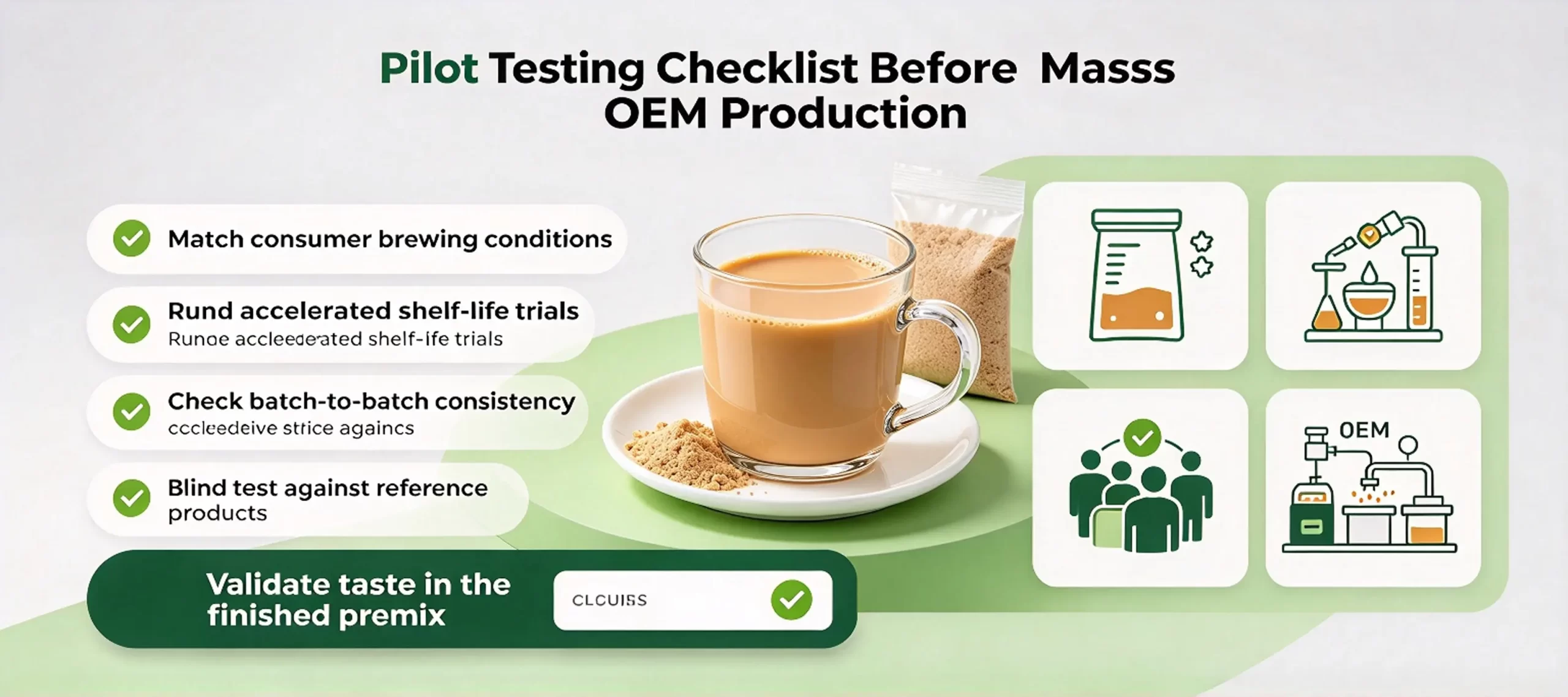
Many private‑label brands pass lab small‑batch sensory test, yet receive consumer complaints after large‑scale stick‑pack manufacturing. Use this checklist before launching bulk instant‑tea OEM:
Test sweetness & after‑taste using final production brewing conditions: water temperature, water ratio, stirring time exactly matching end‑consumer usage. Testing only in lab ideal conditions gives misleading results.
Run accelerated shelf‑life trial. Store finished instant‑milk‑tea powder under elevated temperature & humidity conditions, periodically re‑brew and evaluate taste changes. Some stevia‑related off‑notes become more noticeable after several months of powder storage.
Evaluate multiple batch samples from your sweetener supplier. Natural botanical extracts have slight batch‑to‑batch sensory variation; confirm consistent taste performance across different production lots.
Conduct blind sensory comparison against reference commercial zero‑sugar milk‑tea products in target markets.
Only test stevia in pure water: Milk‑tea premix contains creamer, tea solids. Real‑matrix testing is non‑negotiable.
Chase sweetness by increasing stevia loading: Higher stevia dosage amplifies licorice and bitter notes, almost never solves taste complaints.
Ignore powder‑mixing quality: High‑intensity stevia powder is micro‑dose ingredient. Bad homogenization leads to inconsistent cup‑to‑cup taste for end‑users.
Skip accelerated shelf‑life sensory check: After‑taste may develop gradually during finished‑powder storage.
Source Qualified Stevia Powder & Instant‑Tea OEM Service From Hunan MT Health Inc.
Hunan MT Health supplies different grades of water‑soluble stevia powder tailored for instant‑tea and milk‑tea premix manufacturing. Our stevia series includes high‑purity Reb‑A and premium Reb‑M grades supported by complete COA, Halal, Kosher, ISO22000, CGMP documentation.
Beyond raw‑material supply, our team supports full‑service instant‑tea OEM and private‑label premix development. Our formulation engineers can assist you in adjusting sweetener ratios, running pilot trials and solving stevia‑related sensory challenges for your zero‑sugar milk‑tea projects.
When submitting your inquiry, share your target sweetness profile, premix composition, hot/cold‑brew requirement, target market certification needs and estimated MOQ. This enables our team to recommend suitable stevia grades and formulation suggestions for your instant‑tea product concept.
Contact us to discuss your next zero‑sugar instant‑milk‑tea OEM project.
Website: https://www.instant‑tea‑powder.com/
Q1: Can I completely eliminate stevia after‑taste in instant milk‑tea powder?
A: Complete removal depends on your formula target. Premium Reb‑M grades plus proper sweetener blending can reduce licorice/lingering notes down to consumer‑acceptable levels for most commercial milk‑tea applications. No stevia variant delivers exactly identical sensory profile as sucrose.
Q2: Is Reb‑M stevia always better than Reb‑A for instant‑tea powder?
A: Reb‑M delivers superior taste performance but carries higher raw‑material cost. Reb‑A with smart sweetener blending can work well for cost‑sensitive mid‑range instant‑milk‑tea SKUs. Evaluate based on your brand positioning and budget.
Q3: Does cold‑brew instant tea suffer more stevia after‑taste problems?
A: Yes. Lower water temperature slows sweetener dissolution and release. Cold‑soluble optimized stevia powder grade and thorough dry‑blending are extra critical for cold‑brew instant‑tea premix.
Q4: Should I add masking flavor first to fix stevia bitterness?
A: Prioritize upgrading stevia raw‑material grade and sweetener‑blending ratio first. Flavor masking should be secondary fine‑tuning step, not the primary solution. Poor‑quality low‑grade stevia cannot be fully fixed by adding flavors.
Stevia licorice and lingering after‑taste remains one of the major technical barriers for zero‑sugar instant‑milk‑tea powder OEM. The practical solution chain starts from selecting the correct stevia glycoside grade, optimizing multi‑sweetener blending, tuning premix formula parameters, ensuring powder‑blending quality, and finishing with matrix‑matched pilot & shelf‑life sensory testing.
Do not rely solely on lab water‑solution evaluation. Always validate performance inside your real instant‑milk‑tea premix under real‑world consumer brewing conditions before mass‑scale private‑label production. Partner with an experienced botanical‑ingredient and instant‑tea OEM supplier to shorten your product development cycle and reduce formulation risks.
15874196392
No. A6-608 Lugu International Industrial Park, Yuelu District, Changsha 410205, Hunan, P.R China



 ES
 EN
 FR
 DE
 RU
 TH
 JA
 KO
 AR
 PT
 ZH