15874196392
No. A6-608 Lugu International Industrial Park, Yuelu District, Changsha 410205, Hunan, P.R China
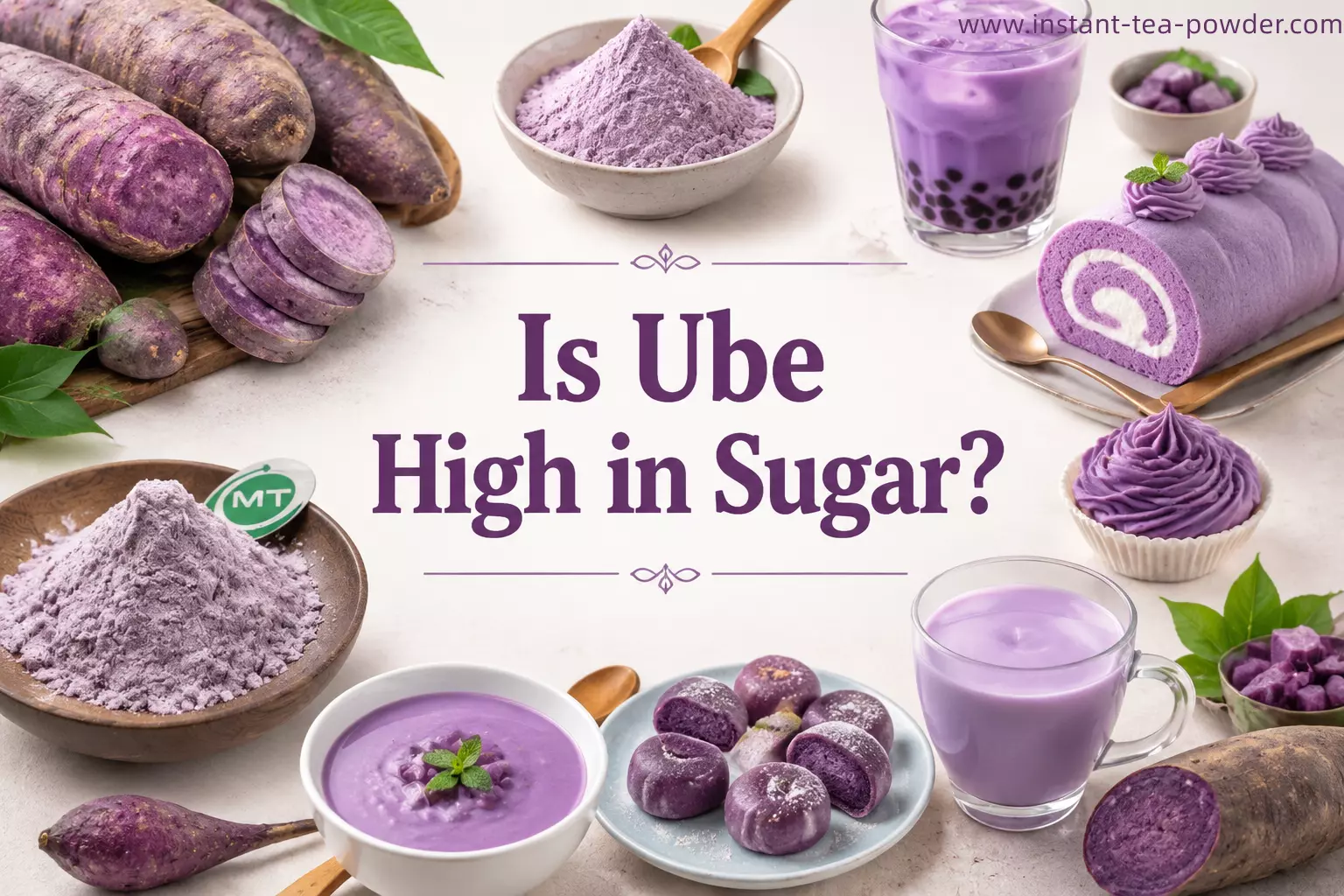
Ube, also known as purple yam (Dioscorea alata), has surged in popularity as a vibrant, naturally purple ingredient in global food and beverage markets. You’ve likely seen it featured in desserts, ice creams, bakery creations, beverages, and even functional food products. But as consumer interest grows, a common question arises:
Is ube high in sugar?
Understanding ube’s sugar content—and how it fits into healthier formulations—is important for product positioning, marketing, and ultimately consumer preference and product performance. At Hunan MT Health, we supply premium ube powder and ube extract designed for stable quality and versatile application in food and nutrition products.
Let’s take a closer look.
Ube (purple yam) is a root vegetable with a naturally vivid purple hue. It is particularly popular in Filipino cuisine and has been adopted in global markets for its:
Ube is often used in desserts, beverages, smoothies, bakery goods, and ice cream because of its visual impact and sensory appeal.
The answer is:
UBE IS NOT INHERENTLY HIGH IN SUGAR ITSELF—BUT ITS NATURALLY OCCURRING CARBOHYDRATES CAN BE PERCEIVED AS SWEET.
Here’s why:
Ube contains natural carbohydrates, including starches and some sugars that occur naturally in root vegetables. These carbohydrates contribute to its mild sweetness—but they are not the same as added sugars.
Many commercial ube products include added sugars to enhance sweetness and consumer appeal, which can make them high in total sugar on nutritional labels. This is a formulation choice, not a reflection of the vegetable itself.
| Component | Approximate Amount |
|---|---|
| Calories | 120–140 kcal |
| Total Carbohydrates | 27–32 g |
| Dietary Fiber | 3–4 g |
| Natural Sugars | 4–7 g |
| Protein | 1–2 g |
| Fat | <1 g |
From this, you can see that most of the carbohydrates are complex carbohydrates (starch) with only modest amounts of naturally occurring sugars. Ube alone doesn’t deliver the same sugar load as added‑sweetened dessert products.
Ube powder used in:
Products such as:
This distinction is crucial when marketing health‑conscious products and when communicating nutritional value to customers and regulatory bodies.
Understanding and accurately communicating ube’s sugar content is important for:
Manufacturers can create no‑added‑sugar or low‑glycemic ube products by:
This allows brands to tap into the low‑sugar and clean‑label market trends.
For product labels, it’s crucial to differentiate:
This improves transparency and supports informed consumer choices, which aligns with global dietary guidance.
Products can be positioned as:
This helps resonate with consumers seeking both visual appeal and nutritional value.
Ube powder from Hunan MT Health is formulated to deliver:
Our ube powder is suitable for a wide range of B2B applications:
By controlling added sugar content in your formulations, you can create products that leverage ube’s natural appeal without contributing to excessive sugar intake.
At Hunan MT Health, we provide:
For food manufacturers, beverage brands, and nutritional product developers, our ube powder provides a reliable base with predictable performance and nutrition‑friendly potential.
No—ube itself is not high in sugar. While it contains natural carbohydrates and modest intrinsic sugars typical of root vegetables, it is not inherently a high‑sugar ingredient. The high sugar content often seen in ube products is usually the result of added sweeteners during formulation rather than the ube itself.
For B2B buyers, understanding this distinction allows you to develop healthier and more transparent products that meet consumer demand for clean‑label, lower‑sugar options without sacrificing taste or appeal.
📩 Contact Hunan MT Health today to request samples, nutrient profiles, or bulk pricing for our premium ube powder.
15874196392
No. A6-608 Lugu International Industrial Park, Yuelu District, Changsha 410205, Hunan, P.R China



 DE
DE  EN
EN  FR
FR  ES
ES  RU
RU  TH
TH  JA
JA  KO
KO  AR
AR  PT
PT  ZH
ZH