15874196392
No. A6-608 Lugu International Industrial Park, Yuelu District, Changsha 410205, Hunan, P.R China
Purple beverages are gaining attention in the bubble tea, instant beverage, and private-label food industries. For brands developing new milk-tea products, purple ingredients offer opportunities to create distinctive colors and differentiate products in a competitive market.
Two ingredients worth considering are Purple Potato Powder and Ube Powder. Although both can contribute purple color to beverage formulations, they come from different plants and may offer different flavor profiles, processing characteristics, and product positioning opportunities.
For instant milk-tea OEM manufacturers, choosing between these ingredients requires more than comparing their appearance. Color consistency, powder dispersion, flavor compatibility, and finished-product stability all matter.
In this guide, we compare Purple Potato Powder and Ube Powder to help beverage brands, ingredient buyers, and OEM manufacturers identify the ingredient that best fits their product development goals.
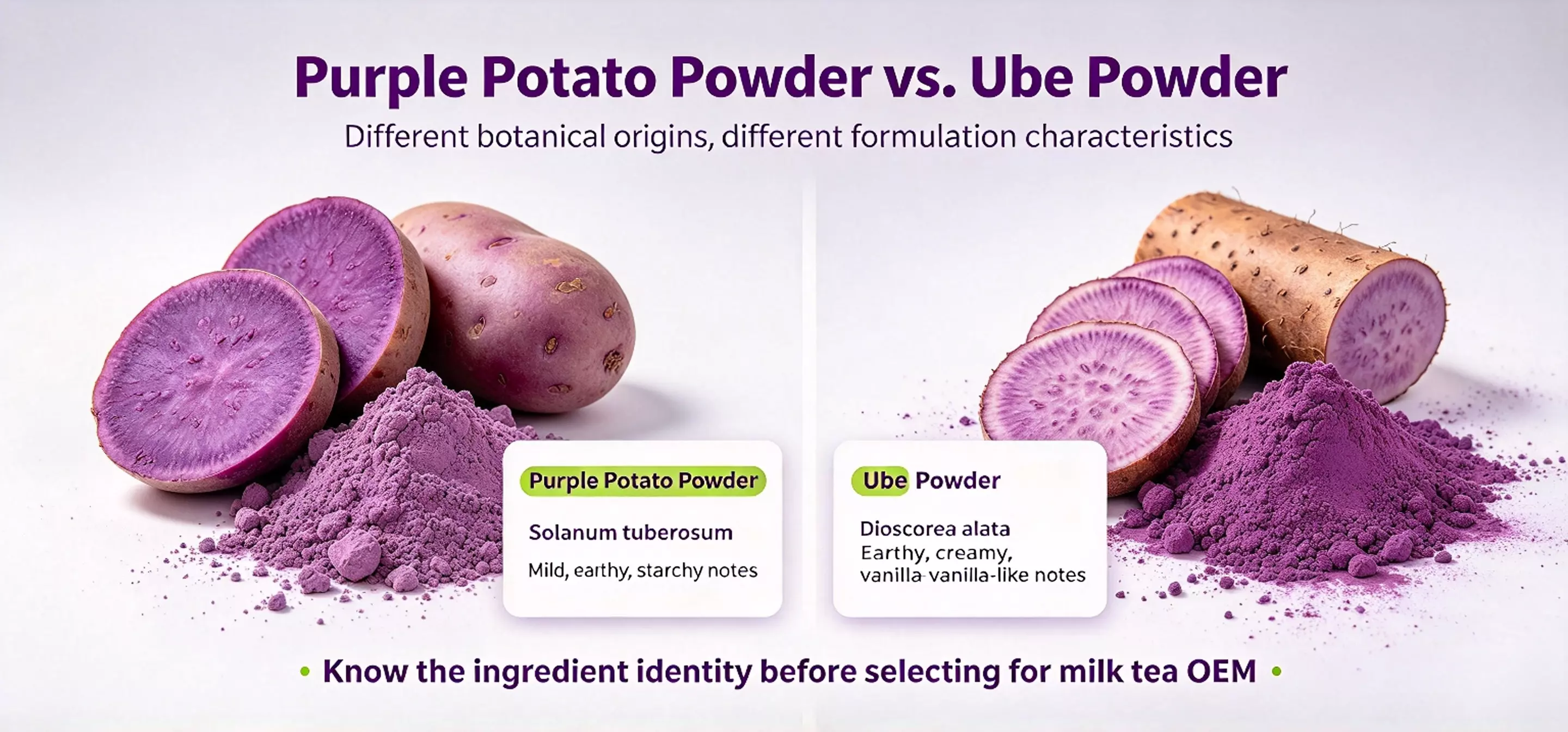
Purple Potato Powder is produced from purple-fleshed potato varieties, generally belonging to Solanum tuberosum. Unlike ordinary white or yellow potatoes, these varieties contain naturally occurring anthocyanins, which contribute to their purple coloration.
Depending on the raw material and processing method, Purple Potato Powder may have a mild earthy flavor, a starchy character, and a color ranging from reddish-purple to deeper violet.
For food and beverage manufacturers, it can be considered for purple beverage premixes, bakery products, dessert formulations, and other applications where a purple potato ingredient is desired.
However, conventional purple potato powder should not automatically be treated as a fully water-soluble ingredient. Its dispersion, texture, and sedimentation behavior depend on particle size, processing technology, and the final formulation.
For instant milk tea, buyers should evaluate whether the powder meets their requirements for appearance, mouthfeel, and preparation convenience.
Ube is a purple yam widely associated with Filipino desserts and specialty beverages. Its botanical name is Dioscorea alata, making it different from the potato used to produce Purple Potato Powder.
Ube Powder is valued for its purple appearance and characteristic flavor, often described as earthy, mildly sweet, and creamy, with vanilla-like notes in some preparations. Actual flavor intensity varies according to the yam variety and manufacturing process.
In beverage development, Ube Powder can be considered for ube-inspired milk tea, dessert drinks, bakery mixes, ice cream, and other specialty food applications.
As with Purple Potato Powder, buyers should distinguish conventional whole-ingredient powder from extracts or specially processed instant ingredients. These formats may differ in flavor intensity, color contribution, and reconstitution performance.
The following table summarizes the main differences relevant to instant milk-tea OEM projects.
| Comparison Factor | Purple Potato Powder | Ube Powder |
|---|---|---|
| Botanical source | Purple-fleshed potato, Solanum tuberosum | Purple yam, Dioscorea alata |
| Natural color compounds | May contain anthocyanins | May contain anthocyanins |
| Typical flavor | Mild, earthy, starchy, sometimes sweet | Earthy, mildly sweet, sometimes creamy or vanilla-like |
| Color contribution | Purple to violet, depending on the variety and process | Purple to lavender or deeper violet, depending on the product |
| Beverage positioning | Purple potato and plant-based ingredient concepts | Ube-inspired specialty and dessert beverages |
| Dispersion | Depends on particle size and processing | Depends on particle size and processing |
| Instant milk-tea suitability | Requires application testing | Requires application testing |
| Main development priority | Color, texture, and dispersion | Flavor identity, color, and dispersion |
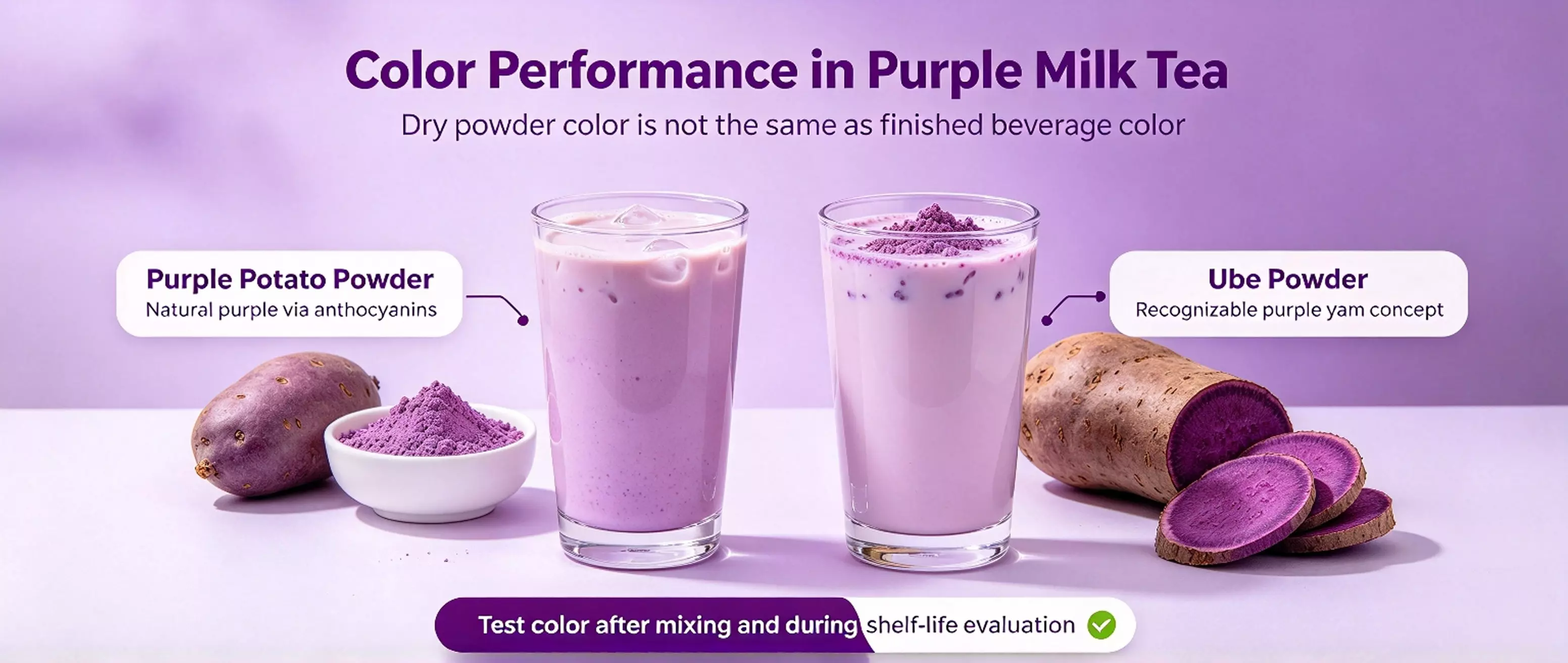
Color is an important consideration when developing purple milk tea, but the appearance of a dry powder does not necessarily predict the final beverage color.
Purple Potato Powder: A Purple Potato Ingredient
Purple Potato Powder can contribute naturally derived purple color through anthocyanins present in the potato. Its final color depends on the potato variety, pigment content, processing conditions, and dosage.
Anthocyanins can be sensitive to pH, heat, oxygen, and storage conditions. Consequently, the color may change during beverage preparation or shelf-life testing.
For OEM projects, Purple Potato Powder is worth evaluating when the product concept emphasizes purple potato as an ingredient and the formulation requires its characteristic color contribution.
Ube Powder: A Purple Yam Beverage Concept
Ube Powder is commonly associated with purple desserts and specialty drinks. Its appeal combines the recognizable ube ingredient with a distinctive flavor profile.
Its color can vary between suppliers and product grades. Milk ingredients, processing temperatures, and other formulation components may also affect the finished beverage’s appearance.
OEM recommendation: Test both ingredients in the actual milk-tea base. Evaluate the color after mixing and after an appropriate holding period, rather than relying only on photographs or the appearance of the dry powder.
If color consistency is a critical specification, request relevant color data and conduct stability testing under the intended processing and storage conditions.
Flavor plays a major role in consumer acceptance and repeat purchases.
Purple Potato Powder generally has a relatively mild, earthy, and starchy profile. Depending on its concentration and processing method, it may contribute a subtle potato note to the beverage. Additional flavoring or sweetening ingredients may be needed to achieve a particular dessert-style flavor.
Ube Powder is often selected for its distinctive purple yam flavor and association with specialty desserts. It may suit milk-tea formulations designed around an ube-inspired taste, although the flavor intensity of commercial powders can vary.
For beverage brands, the choice depends on the intended product identity:
Choose Purple Potato Powder when developing a purple potato-based beverage concept with a relatively mild flavor profile.
Choose Ube Powder when the product is intended to feature the recognizable flavor identity of ube.
Test both ingredients when color is the primary objective and the final flavor profile will be developed through the complete formulation.
Neither powder should be assumed to replace all flavoring, sweetening, or texturizing ingredients in a finished instant milk-tea mix.
For instant beverage manufacturers, powder handling and reconstitution can directly affect product quality.
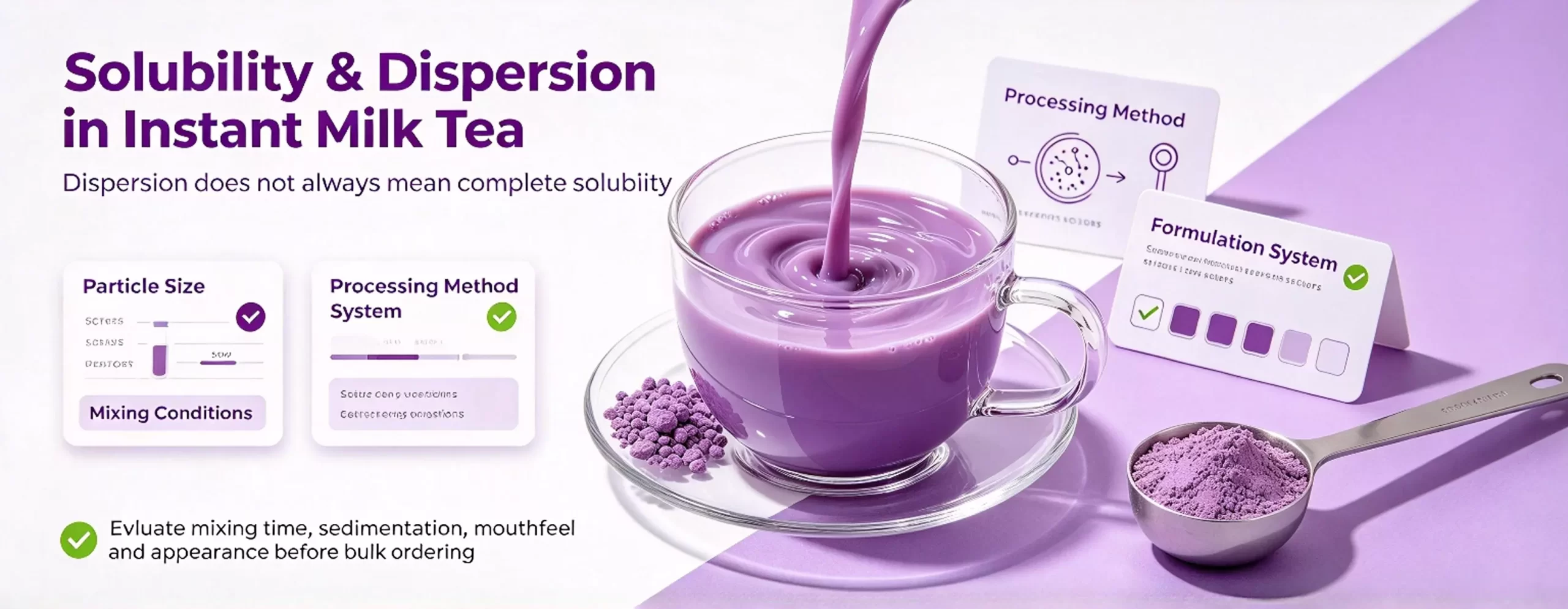
A key distinction is that dispersion and solubility are not the same. A powder may spread throughout water but still contain insoluble plant components that remain suspended or settle over time.
Both conventional Purple Potato Powder and Ube Powder may exhibit this behavior.
Several factors influence their performance:
Particle size: Finer particles may improve mouthfeel and dispersion, but do not automatically make the powder water-soluble.
Processing method: Drying, milling, and other treatments can affect wettability and reconstitution.
Formulation: Milk powder, sweeteners, stabilizers, and other ingredients may influence suspension and texture.
Mixing conditions: Water temperature, mixing time, and agitation can change the result.
Storage conditions: Moisture control and packaging are important for maintaining powder quality.
Before placing a bulk order, OEM buyers should test the powder in the intended recipe and evaluate mixing time, sedimentation, mouthfeel, and finished-product appearance.
If rapid reconstitution and minimal sediment are essential, ask the supplier whether a specially processed instant grade or alternative ingredient format is available.
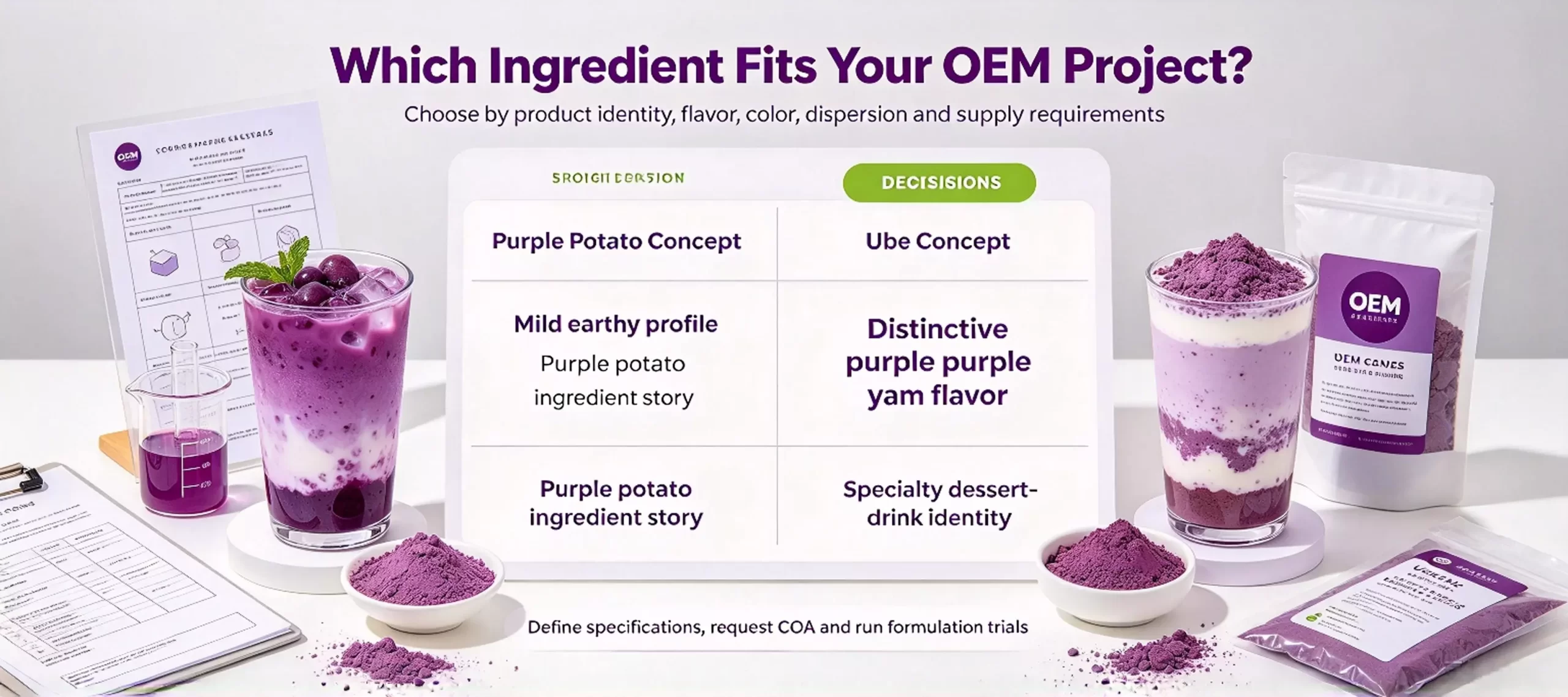
The best choice depends on your product concept, technical requirements, and target market.
Purple Potato Powder may be suitable for brands exploring purple potato ingredients in beverage and food applications. Ube Powder may be more appropriate for products built around the flavor and identity of purple yam.
Before finalizing the ingredient, define the following requirements:
Target color: Specify the desired shade and acceptable batch-to-batch variation.
Flavor profile: Decide whether the beverage should have a mild potato character or a recognizable ube flavor.
Reconstitution performance: Establish acceptable mixing time, dispersion, and sedimentation.
Processing conditions: Confirm compatibility with your mixing, drying, and packaging processes.
Quality documentation: Request a product specification, Certificate of Analysis (COA), and applicable food safety documentation.
Supply requirements: Confirm sample availability, minimum order quantity, packaging options, and production lead time.
A small-scale formulation trial is recommended before commercial production. It allows your team to assess the ingredient under realistic preparation and storage conditions.
Hunan MT Health Inc. supplies botanical and food ingredient powders for food, beverage, and related industrial applications. Our product portfolio includes Purple Potato Powder and Ube Powder for manufacturers developing distinctive purple food and beverage concepts.
For instant milk-tea OEM projects, selecting an appropriate ingredient involves more than color. Botanical identity, product specifications, dispersion, sensory performance, and reliable supply all contribute to successful formulation development.
Our team welcomes inquiries from B2B buyers seeking product information, samples, bulk ingredient supply, and customized packaging solutions.
When contacting us, please share your target application, preferred color, flavor requirements, estimated order quantity, and reconstitution expectations. This information helps our team understand your project and discuss suitable ingredient options.
Contact Hunan MT Health to explore Purple Potato Powder and Ube Powder for your next instant milk-tea project.
Is Purple Potato Powder the same as Purple Sweet Potato Powder?
No. Purple Potato Powder is made from purple-fleshed potatoes, generally classified as Solanum tuberosum. Purple Sweet Potato Powder is made from purple-fleshed sweet potatoes, which belong to Ipomoea batatas. They are different crops and should be specified separately when purchasing ingredients.
Is Purple Potato Powder the same as Ube Powder?
No. Purple Potato Powder comes from purple-fleshed potatoes, while Ube Powder comes from purple yam (Dioscorea alata). Their botanical origins, flavors, and formulation characteristics differ.
Which powder is better for instant milk tea?
Neither is universally better. Purple Potato Powder may suit purple potato-based beverage concepts, while Ube Powder may suit drinks centered on ube flavor. The final choice should be based on application testing.
Are Purple Potato Powder and Ube Powder completely water-soluble?
Not necessarily. Conventional whole-ingredient powders may disperse without dissolving completely. Performance depends on raw material, processing, particle size, and formulation.
What should OEM buyers request before ordering?
Buyers should request botanical identity, technical specifications, a COA, applicable food safety documentation, and samples for formulation testing. For instant milk tea, dispersion, taste, color, and sedimentation should be evaluated before bulk purchasing.
Purple Potato Powder and Ube Powder offer different opportunities for instant milk-tea development. Purple Potato Powder provides a purple potato ingredient option, while Ube Powder supports beverage concepts built around the distinctive identity of purple yam.
For OEM manufacturers, the most suitable ingredient is the one that meets the project’s requirements for color, flavor, dispersion, consistency, and cost.
Evaluate both ingredients in your actual formulation, verify their specifications, and work with a supplier that can support your commercial requirements. This approach provides a more reliable basis for developing a purple milk-tea product that is technically suitable and commercially competitive.
15874196392
No. A6-608 Lugu International Industrial Park, Yuelu District, Changsha 410205, Hunan, P.R China



 EN
 FR
 DE
 ES
 RU
 TH
 JA
 KO
 AR
 PT
 ZH